

Key points
- Forms 1099-NEC and 1099-MISC are required at $2,000 per payee for payments made in 2026 (filed in early 2027); 2025 payments filed in early 2026 kept the $600 threshold.
- The threshold is indexed for inflation: Revenue Procedure 2026-35 sets it at $2,100 for 2027 payments, and backup withholding follows the same amount.
- Royalties ($10), attorney gross proceeds ($600), most 1099-INT interest ($10) and 1099-DIV dividends ($10) did not move to $2,000.
- Payment apps file Form 1099-K only above $20,000 and 200 transactions, restored retroactively; card payments are reported at any amount.
- 2026 Forms 1099-NEC are due February 1, 2027, and filers with 10 or more returns must e-file through IRIS because FIRE closed on November 19, 2026.
The 1099 threshold for 2026 is $2,000. For payments made on or after January 1, 2026, a business files Form 1099-NEC for nonemployee compensation, and Form 1099-MISC for rents, prizes and other income, only when a payee receives $2,000 or more in the calendar year, up from $600. Payments made in 2025 kept the $600 threshold, so the forms filed in early 2026 did not change. The new amount first applies to the 1099s due in early 2027, and it rises to $2,100 for 2027 payments.
What is the 1099 threshold for 2026?
For payments a business makes in 2026, the federal threshold for nonemployee compensation, rents, prizes, awards, other income and most other 1099-MISC payments is $2,000 per payee for the calendar year. Below that amount you do not file the form with the IRS or send a copy to the payee. At $2,000 or more, you do both.
Three points cause most of the confusion:
- The payment date decides. The new amount applies to payments made after December 31, 2025. Work done in December 2025 but paid in January 2026 falls under the $2,000 rule.
- It is not a tax exemption. Payees must still report all of their income on their own returns, whether or not they receive a 1099.
- Not every 1099 threshold moved. Royalties, attorney gross proceeds, interest and dividends keep their own thresholds.
How the 1099 reporting threshold changed
Section 70433 of the One Big Beautiful Bill Act (Public Law 119-21) replaced “$600” with “$2,000” in Internal Revenue Code section 6041(a), effective for payments made after December 31, 2025. It tied the section 6041A(a) threshold for nonemployee compensation and the section 3406 backup withholding threshold to the same amount, and it added inflation indexing for calendar years after 2026. The $600 level had been in place since 1954.
The IRS has written the change into the Instructions for Forms 1099-MISC and 1099-NEC (Rev. December 2026) and the 2026 Publication 1099. Treasury also published proposed regulations (REG-113229-25) on April 17, 2026, to replace the old $600 references in the regulations. Those regulations are not yet final, but the statute applies either way. The new threshold is one line on the year-end payroll checklist, next to W-2 and e-filing deadlines.
1099 threshold for 2025 vs 2026 payments: which forms use $2,000?
The year you paid decides the threshold, not the year you file. Forms filed in January and February 2026 reported 2025 payments, so they used $600. Forms due in early 2027 report 2026 payments, so they use $2,000.
| Item | 2025 payments (filed in early 2026) | 2026 payments (filed in early 2027) | 2027 payments (filed in early 2028) |
|---|---|---|---|
| Form 1099-NEC (nonemployee compensation) | $600 or more | $2,000 or more | $2,100 or more |
| Form 1099-MISC: rents, prizes, awards, other income, medical payments | $600 or more | $2,000 or more | $2,100 or more |
| Form 1099-MISC: royalties | $10 or more | $10 or more | $10 or more |
| Form 1099-MISC: gross proceeds paid to attorneys | $600 or more | $600 or more | $600 or more |
| Form 1099-K: payment apps and online marketplaces | Over $20,000 and over 200 transactions | Over $20,000 and over 200 transactions | Over $20,000 and over 200 transactions |
| Form 1099-K: credit and debit card payments | Any amount | Any amount | Any amount |
| Backup withholding (24%) on 1099-NEC and most 1099-MISC payments | Payee total of $600 or more | Payee total of $2,000 or more | Payee total of $2,100 or more |
| Form 1099-NEC due date (recipient and IRS) | February 2, 2026 (January 31 was a Saturday) | February 1, 2027 (January 31 is a Sunday) | January 31, 2028 |
The 1099-K rows are the same in every column because Congress restored the $20,000 test retroactively. The 2027 column comes from the first inflation adjustment, covered below.
1099-NEC threshold 2026: how the $2,000 rule works
File Form 1099-NEC for each person you paid at least $2,000 during 2026 for services in the course of your trade or business. Under the IRS instructions, a payment is nonemployee compensation when all four of these are true:
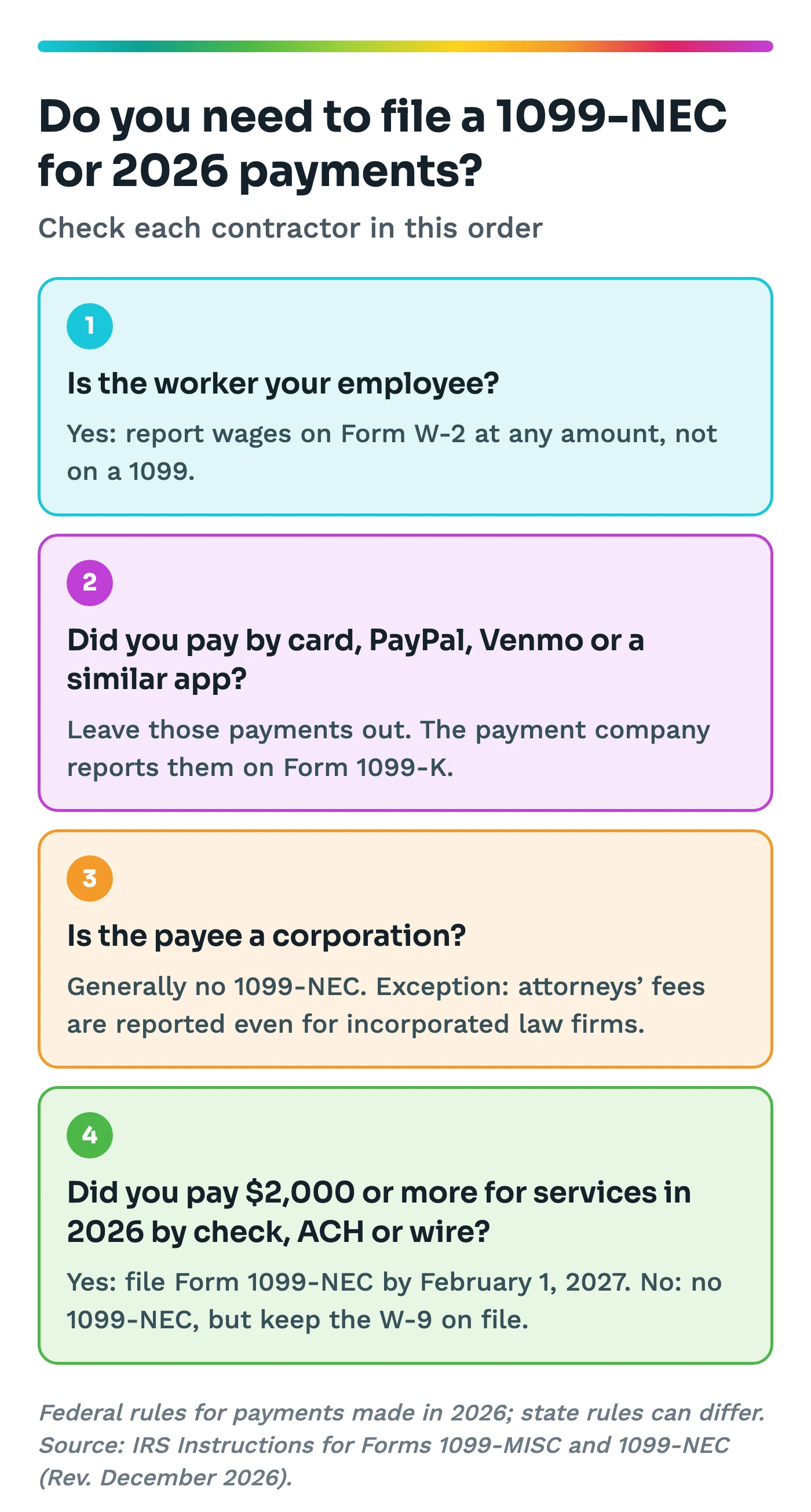
- The payee is not your employee.
- The payment is for services in the course of your trade or business. Payments by nonprofits and government agencies are covered too.
- The payee is an individual, partnership or estate, or in some cases a corporation.
- Your payments to that payee total at least $2,000 for the year.
Counting payments per payee
Add up everything paid to the same payee for services during the calendar year: fees, commissions, parts and materials supplied with the service, and travel reimbursements the contractor did not account to you for. At $1,950 for the year, no form is needed. If a final invoice takes the total to $2,050, you report the full $2,050 in box 1a. Personal payments, such as paying a painter for work on your own home, are not reportable.
Payments to corporations and attorneys
Payments to corporations are generally exempt, with exceptions. Attorneys’ fees of $2,000 or more go on Form 1099-NEC even when the law firm is incorporated. Medical and health care payments reported on Form 1099-MISC are also reportable to corporations.
Employees, contractors and the new 1099-NEC boxes
The threshold only matters once a worker is correctly treated as a contractor. Wages paid to employees go on Form W-2 at any amount, so apply the independent contractor vs employee test before relying on a 1099. The December 2026 revision of Form 1099-NEC moves nonemployee compensation to box 1a and adds boxes 1b (cash tips), 1c (Treasury Tipped Occupation Codes) and 1d (qualified overtime compensation). Those boxes follow the same rules as the employee-side no tax on overtime W-2 reporting and affect few contractors.
1099-MISC threshold 2026 and the 1099 thresholds that did not change
Most Form 1099-MISC boxes moved to $2,000 together with Form 1099-NEC. The ones that did not move are set by other Code sections that the 2025 law left alone.
1099-MISC boxes that moved to $2,000
- Box 1: rents, such as office space, equipment and machine rentals.
- Box 3: prizes, awards and other income.
- Box 6: medical and health care payments.
- Box 9: crop insurance proceeds.
- Boxes 12 and 15: section 409A deferrals and nonqualified deferred compensation for nonemployees.
1099-INT threshold, royalties and attorney payments
These thresholds stayed where they were, according to the Guide to Information Returns in the 2026 Publication 1099 and the 2026 form instructions:
- Royalties (1099-MISC box 2): $10 or more.
- Gross proceeds paid to attorneys (1099-MISC box 10): $600 or more, for example a settlement paid through a claimant’s lawyer. Attorneys’ fees for services are different: they moved to $2,000 on Form 1099-NEC.
- Cash paid for fish bought for resale (1099-MISC box 11): $600 or more.
- Direct sales of consumer products for resale: $5,000 or more, reported on either form.
- Form 1099-INT: $10 or more for most interest. The narrower $600 rule for interest paid in the course of a trade or business that is not otherwise reportable is shown at $2,000 in the 2026 Publication 1099.
- Form 1099-DIV: $10 or more of dividends.
- Any payment with backup withholding: if you withheld, you must file the 1099 and report the tax in box 4, whatever the amount.
1099-K threshold 2026: back to $20,000 and 200 transactions
Form 1099-K is filed by payment processors, not by the business that pays a vendor. For third party settlement organizations (TPSOs), meaning payment apps and online marketplaces, the 1099-K threshold is more than $20,000 in payments and more than 200 transactions in the calendar year. Both tests must be met. Card processors report credit and debit card payments at any amount.
What happened to the $600 and $5,000 phase-in?
The American Rescue Plan Act of 2021 cut the TPSO threshold to $600 with no transaction count. The IRS delayed it several times, and Notice 2024-85 set a phase-in: more than $5,000 for 2024, more than $2,500 for 2025 and more than $600 from 2026. Section 70432 of the OBBBA reversed the 2021 change as if it had been part of the original law, so the $20,000 and 200-transaction test applies again and the $600 level never takes effect. The Instructions for Form 1099-K (Rev. December 2026) reflect this.
The same section limits backup withholding by TPSOs, for calendar years after 2024, to payees who pass the $20,000 and 200-transaction test or whose payments were reportable in the previous year. Platforms may still send a 1099-K for smaller amounts. Money from friends and family for gifts or shared expenses should not be reported on Form 1099-K. State reporting rules can differ from the federal ones, so check your state revenue department.
1099-K vs 1099-NEC: paying vendors by card, PayPal or Venmo
Payments you make to a contractor by credit card, debit card or through a third party settlement organization are reported by the payment settlement entity on Form 1099-K, not by you on Form 1099-NEC or 1099-MISC. The IRS applies this rule even when the payee’s total stays under the $20,000 and 200-transaction test. Leave those payments out of your 1099-NEC totals and count checks, ACH and wire payments.
Do you still need a W-9 from vendors paid under $2,000?
No federal rule requires a Form W-9 from a vendor you will never have to report. Most AP teams should still collect one at onboarding, for four reasons:
- You rarely know in January whether a vendor will cross $2,000 by December, and chasing taxpayer identification numbers (TINs) during filing season is slow.
- Lower thresholds still apply to royalties ($10) and attorney gross proceeds ($600).
- The W-9 shows whether the vendor is a corporation or another exempt payee, which decides whether a 1099 is needed at all.
- A W-9 on file before the threshold is reached avoids backup withholding problems later.
Backup withholding and the new threshold
The OBBBA moved the backup withholding trigger for these payments to the same amount as the reporting threshold. The IRS explains that payments totaling less than $2,000 for 2026 are not reportable payments, so they do not require backup withholding. Once a payee without a TIN on file reaches $2,000, its payments become reportable and you must withhold 24%. Nonemployee compensation gets no 60-day grace period for an “applied for” TIN, and a payer that fails to withhold when required can be liable for the uncollected tax.
Checking vendor names and TINs through the IRS TIN Matching program before filing should mean fewer CP2100 “B notices.” The recorded Form W-9 compliance webinar walks through TIN solicitation, verification and B notice procedures.
1099 threshold 2027: will it be adjusted for inflation?
Yes, and the first adjusted figure is already out. Revenue Procedure 2026-35, released with the IRS’s tax year 2027 inflation adjustments on November 5, 2026, sets the section 6041(a) reporting threshold at $2,100 for payments made in calendar year 2027. The Form 1099-NEC and backup withholding thresholds are tied by statute to the section 6041(a) amount, so they also move to $2,100.
Under new section 6041(h), the $2,000 base is adjusted each calendar year after 2026 using 2025 as the base year, and the result is rounded to the nearest $100, so the threshold moves in $100 steps. The $2,100 amount applies to forms filed in early 2028, not to the forms due in early 2027. The 1099-K test, the $10 royalty threshold and the $600 attorney gross proceeds threshold are not indexed.
What to do now: 1099-NEC due date and filing checklist
Forms 1099-NEC for 2026 are due to recipients and to the IRS by February 1, 2027, because January 31, 2027 falls on a Sunday. Form 1099-MISC goes to recipients by the same date (later for amounts in boxes 8 and 10) and to the IRS by March 1, 2027 on paper or March 31, 2027 if you e-file.
E-filing has changed too. If you file 10 or more information returns of all types combined, you must e-file. The IRS stopped accepting files through its FIRE system on November 19, 2026. From January 1, 2027, IRIS (the Information Returns Intake System) is the only IRS e-file system for information returns, including corrections, and a FIRE Transmitter Control Code (TCC) does not work in IRIS. The free IRIS Taxpayer Portal accepts up to 100 returns at a time.
- Split vendor payments by the year paid. Run 2026 totals against $2,000 by payment date, not invoice date, and keep $600 for any late 2025 corrections.
- Update the 1099 settings in your AP or accounting system. Set $2,000 for 2026 and $2,100 for 2027, keep $10 for royalties and $600 for attorney gross proceeds, and exclude card and payment-app payments.
- Review vendors paid between $600 and $2,000 in 2026. They no longer need a federal 1099-NEC or 1099-MISC unless you backup withheld, but check your state’s rules before dropping them.
- Keep collecting W-9s at onboarding and run TIN Matching on new vendors before January.
- Apply for an IRIS TCC now if you do not have one. The IRS says a typical application is processed within 45 business days, so one filed in January may not be approved before the February 1 deadline.
- Put February 1, 2027 on the calendar. For returns due in 2027, the penalty is $60 per return if filed up to 30 days late, $130 through August 1 and $340 after that, with a $690 minimum for intentional disregard. Separate penalties apply to late payee statements.
More sessions on information returns and year-end reporting are listed under payroll and taxation webinars.
Frequently asked questions
What is the 1099 threshold for 2026?
For payments made in 2026, Forms 1099-NEC and 1099-MISC are required when a payee receives $2,000 or more in the calendar year, up from $600. Some payments keep lower thresholds, including royalties ($10) and gross proceeds paid to attorneys ($600).
Does the $2,000 threshold apply to 1099s filed in January 2026?
No. Forms filed in early 2026 reported payments made in 2025, which still used the $600 threshold. The $2,000 threshold first applies to 2026 payments reported on forms due February 1, 2027.
Do I need to send a 1099 to a contractor I paid $1,500 in 2026?
Not for federal purposes, as long as the payments were nonemployee compensation and you did not backup withhold. The contractor must still report the $1,500 as income. Check whether your state has its own filing rule.
What is the 1099-K threshold for 2026?
Payment apps and online marketplaces must file Form 1099-K only when a payee receives more than $20,000 in more than 200 transactions in the year. The rule was restored retroactively, so the planned $2,500 (2025) and $600 (2026) thresholds never take effect. Card processors still report card payments at any amount.
What is the 1099 threshold for 2027?
$2,100. Revenue Procedure 2026-35 sets the section 6041(a) reporting threshold at $2,100 for payments made in 2027, which applies to Forms 1099-NEC and 1099-MISC filed in early 2028. The threshold is adjusted for inflation each year in $100 steps.
Is income under $2,000 still taxable?
Yes. The threshold only decides whether the payer files an information return. Contractors and other payees must report all business income on their tax returns, whether or not they receive a Form 1099.
Get payroll and tax rule changes by email
Subscribe to the 247Compliance newsletter for updates on IRS reporting changes and new payroll and taxation webinars.
SubscribeSources (18)
- Public Law 119-21 (One Big Beautiful Bill Act), sections 70432 and 70433
- IRS: Instructions for Forms 1099-MISC and 1099-NEC (Rev. December 2026)
- IRS: Form 1099-NEC (Rev. December 2026)
- IRS: Publication 1099 (2026), General Instructions for Certain Information Returns
- IRS: Instructions for Form 1099-K (Rev. December 2026)
- IRS: Understanding your Form 1099-K
- IRS: Form 1099-K FAQs: Should my organization be preparing, filing and furnishing Form 1099-K?
- IRS Notice 2024-85: Form 1099-K transition relief for TPSOs
- IRS Revenue Procedure 2026-35 (2027 inflation adjustments, section 3.52 payment reporting threshold)
- IRS IR-2026-133: IRS releases tax inflation adjustments for tax year 2027 (Nov. 5, 2026)
- Federal Register: Proposed regulations REG-113229-25, Increase in Threshold for Requiring Information Reporting With Respect to Certain Payees (91 FR 20599, April 17, 2026)
- IRS IR-2026-99: Information return e-file system transitioning to a new platform (FIRE retirement)
- IRS: Filing Information Returns Electronically (FIRE) retirement notice
- IRS: Information return penalties
- IRS: Instructions for the Requester of Form W-9 (Rev. March 2024)
- IRS: Backup withholding
- IRS: Understanding the Working Families Tax Cuts: Business Tax Provisions (video text script)
- IRS: Instructions for Forms 1099-INT and 1099-OID (Rev. January 2024)
This article is general information, not legal or tax advice. Check the official sources above or consult a qualified advisor for your situation.
 LIVE WEBINAR · 20 NOV · 10:00 AM PT · 1:00 PM ET
Accounting For Non Accountants : Debit, Credits And Financial Statements
Richard E Cascarino · 60 min · from $179
Enroll