

Key points
- Overtime and tips are still taxed and withheld; the deduction is claimed by eligible employees on Schedule 1-A for 2025–2028.
- Box 12 code TT reports only the FLSA-required premium: for each workweek, hours over 40 × one-half of the FLSA regular rate (bonuses included), with no cap applied.
- Box 12 code TP reports cash tips reported to the employer, and box 14b holds up to two Treasury Tipped Occupation Codes (“000” for unlisted jobs).
- State-only, union-contract and double-time premiums above the FLSA minimum are not qualified overtime.
- 2026 Forms W-2 are due February 1, 2027, and errors in code TT need a Form W-2c because employees cannot deduct unreported amounts.
“No tax on overtime” does not make overtime tax-free. The One Big Beautiful Bill Act gives eligible workers an income tax deduction for qualified overtime compensation and qualified tips for tax years 2025 through 2028. No tax on overtime W-2 reporting becomes mandatory with the 2026 Form W-2, which is due to employees by February 1, 2027, so employers must now report qualified overtime and tips separately.
2026 W-2 changes: what’s new compared with 2025?
For tax year 2025, separate reporting was voluntary. Notice 2025-62 waived penalties for employers that did not separately report cash tips, tipped occupations or qualified overtime on 2025 forms, as long as the rest of the return was complete and correct. The 2025 Form W-2 was never redesigned for the new deductions.
That relief does not carry into 2026. The IRS has issued the final 2026 Form W-2 and the 2026 General Instructions for Forms W-2 and W-3. They add three box 12 codes and split box 14 into two boxes. In Fact Sheet FS-2026-13 (August 2026), the IRS says an employee can deduct only the qualified overtime that the employer reports on a properly furnished Form W-2, and that no relief from that rule applies after 2025. A missing or low code TT amount therefore costs the employee part of the deduction, and the employer can face information-return penalties. Code TT is one item on a longer year-end list; the year-end payroll checklist covers the rest.
No tax on overtime: is overtime tax-free in 2026?
No. Overtime and tips are still wages. They stay in box 1 and remain subject to federal income tax withholding, Social Security tax, Medicare tax and FUTA, just as before. The deduction is claimed by the employee on Schedule 1-A of Form 1040, and only for a portion of the pay. Payments to independent contractors are not wages: they go on Form 1099-NEC, never carry a code TT amount, and the 1099 threshold for 2026 has changed too.
The limits that apply on the employee’s return are:
- Overtime: up to $12,500 of qualified overtime per return ($25,000 on a joint return).
- Tips: up to $25,000 of qualified tips.
- Income phase-out: both deductions shrink once modified adjusted gross income passes $150,000 ($300,000 for joint filers).
- Other conditions: the worker needs a Social Security number valid for employment, and married workers must file jointly.
The employer does not apply any of these caps. If an employee earned $30,000 of qualified overtime, the full $30,000 goes in box 12 with code TT, even though the deduction tops out at $12,500 (FS-2026-13, Q10).
Payroll also cannot reduce income tax withholding on its own initiative. Under FS-2026-13 (Q8), withholding changes only when the employee files a new Form W-4 claiming the expected deduction in Step 4(b) of the 2026 form.
What counts as qualified overtime compensation?
Qualified overtime compensation is the part of overtime pay that section 7 of the Fair Labor Standards Act requires above the employee’s regular rate. Under ordinary time-and-a-half, that is the “half.” The full 1.5 times rate is not qualified.
Some overtime does not qualify at all:
- Exempt employees: an employee who is exempt from FLSA overtime has no qualified overtime, even when a union contract or company policy pays them overtime.
- Owners: an employee who owns at least a bona fide 20% equity stake and is actively engaged in management is generally treated as an exempt executive.
- Premiums above the FLSA minimum: with double time, only the FLSA-required half-time premium counts.
- State-only overtime: daily overtime (such as California’s overtime after eight hours in a workday), weekend premiums and overtime after 35 hours do not count unless the FLSA would also have required the pay.
Employees properly classified as exempt have no FLSA-required overtime to report, so check the FLSA exempt salary threshold and duties tests rather than relying on a job title.
How to calculate qualified overtime
The IRS’s basic weekly formula is:
FLSA hours over 40 in the workweek × one-half × the employee’s FLSA regular rate = qualified overtime for that week.
To build the code TT amount for each employee:
- Confirm the employee is FLSA nonexempt. Exempt employees, 20% owners and contract-only overtime produce no qualified overtime.
- Work one workweek at a time. Count the hours worked over 40 in each workweek. Each workweek stands alone, and hours cannot be averaged across weeks.
- Find the FLSA regular rate for that week. Divide the week’s total pay, minus the payments the FLSA excludes, by the total hours worked (29 CFR 778.109). The FLSA regular rate includes nondiscretionary bonuses and shift differentials, so it is often higher than the base hourly rate.
- Multiply the overtime hours by one-half of the regular rate. That is the qualified overtime for the week, whatever premium you actually paid.
- Add every workweek in the calendar year. The total goes in box 12 with code TT, with no cap applied.
Worked examples: time-and-a-half, double time and state overtime
| Scenario ($20/hour base rate) | Overtime paid | Code TT amount |
|---|---|---|
| 50 hours in the workweek, paid time-and-a-half | 10 hours × $30 = $300 | $100 (10 × $10) |
| 50 hours in the workweek, paid double time | 10 hours × $40 = $400 | $100 (only the FLSA-required half) |
| 45 hours at $20/hour plus a $100 nondiscretionary weekly production bonus | Regular rate = ($900 + $100) ÷ 45 hours = $22.22; half-time premium for 5 hours = $55.56 | $55.56 (5 × $11.11) |
| Two 10-hour days, 38 hours total, state daily overtime paid | 4 hours × $30 = $120 | $0 (the FLSA requires no overtime under 40 hours) |
| Exempt manager paid overtime under a union contract | Any amount | $0 (not FLSA overtime-eligible) |
The double-time row comes from the IRS’s own example in FS-2026-13 (Q16). When a week mixes state daily overtime with more than 40 hours, apply FLSA sections 7(e) and 7(h) to find the amount the FLSA required, and report only that. Hospitals using the 8/80 system and public employers using section 7(k) or 7(o) compensatory time follow special rules: FAQs 17 and 18 cover them, including when comp time counts as paid.
No tax on tips: qualified tips and W-2 code TP
Qualified tips are voluntary cash or charged tips, including tips received through a tip-sharing arrangement, in an occupation on the Treasury list of jobs that customarily and regularly received tips on or before December 31, 2024. Mandatory service charges and automatic gratuities are not tips. The final regulations (T.D. 10044, published April 13, 2026) made the occupation list final and exhaustive. They also exclude tips received in a specified service trade or business and tip-pool amounts paid to managers or supervisors.
The employer’s W-2 job is narrower than deciding whether each tip is qualified. Box 12 code TP reports the total cash tips the employee reported to the employer. Box 14b reports the occupation code. The Treasury Tipped Occupation Codes are three-digit numbers, such as 101 for bartenders and 102 for wait staff. The 2026 instructions set these rules for box 14b:
- Enter up to two codes for the occupations in which the employee received tips.
- If the employee received tips in three or more occupations, enter any two of them.
- If any tips came from an occupation not on the list, one of the codes must be “000.”
- If “000” is the only code, the employee instructions say the code TP amount is not qualified tips.
Tips of $20 or more in a month remain subject to income tax withholding, Social Security tax and Medicare tax, as before.
W-2 box 12 code TT, code TP and box 14b: where each amount goes
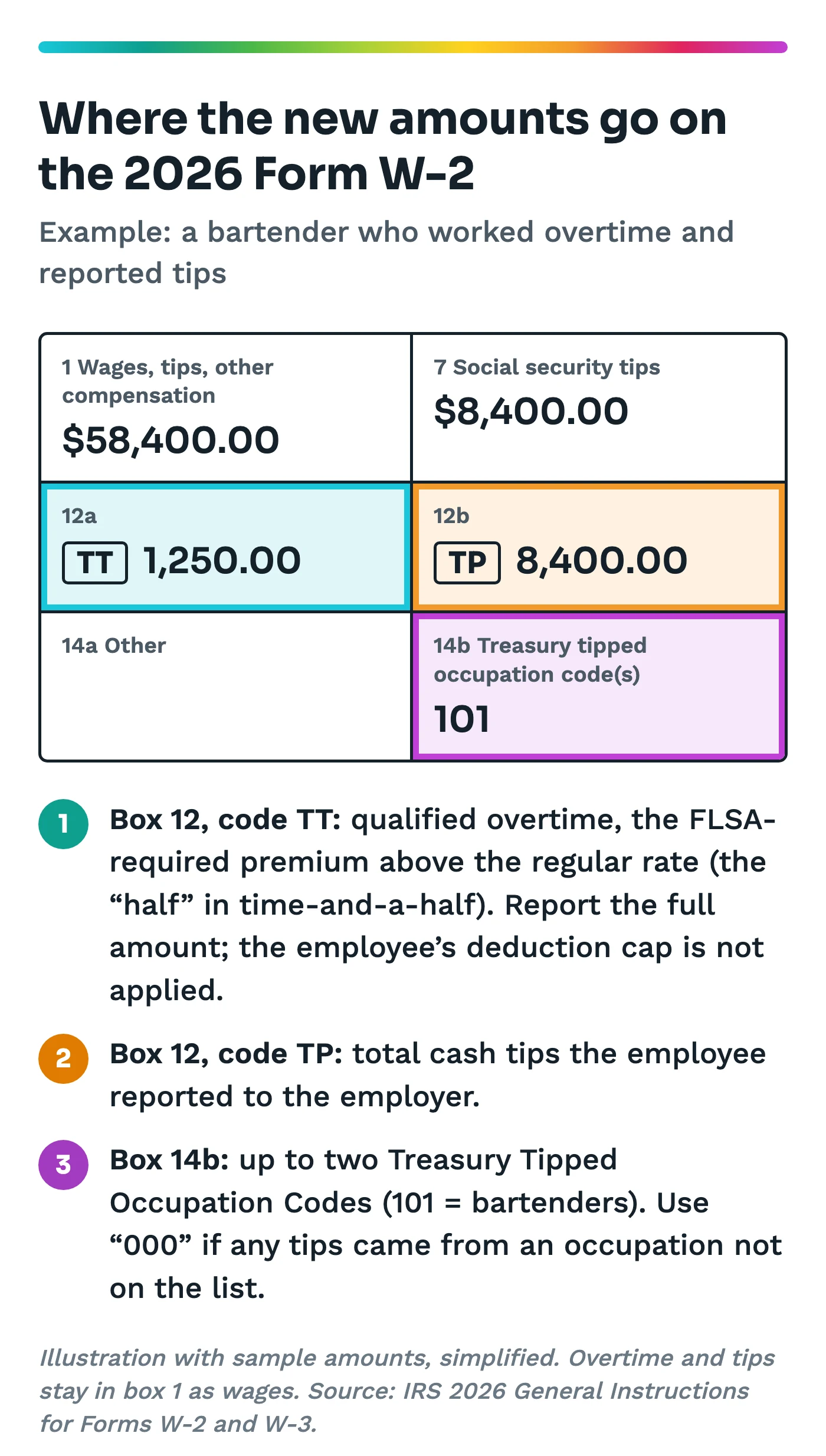
| Item | What to report | Where on the 2026 W-2 | Source |
|---|---|---|---|
| All wages, including overtime and tips | Full taxable amounts, as before | Boxes 1, 3, 5 and 7 (Social Security tips) | 2026 W-2/W-3 instructions |
| Qualified overtime compensation | Total FLSA-required premium above the regular rate, with no cap applied | Box 12, code TT | W-2/W-3 instructions; FS-2026-13 Q10 |
| Cash tips | Total cash and charged tips the employee reported to the employer | Box 12, code TP | W-2/W-3 instructions |
| Tipped occupation | Up to two Treasury Tipped Occupation Codes; “000” if any tips came from an unlisted occupation | Box 14b | W-2/W-3 instructions |
| Employer Trump account contributions | Contributions under a section 128 program (permitted from July 4, 2026) | Box 12, code TA | W-2/W-3 instructions |
| Items formerly in box 14 “Other” | Same items as before | Box 14a | W-2/W-3 instructions |
| Errors in TT, TP or box 14b | Corrected amounts or codes | Form W-2c (box 12 or box 14b) | FS-2026-13 Q11; W-2c instructions |
Paper filers should check box 12 capacity. Copy A of a paper Form W-2 holds only four box 12 entries. An employee with codes DD, D, W, TT and TP needs a second Form W-2, and the second form counts toward the 10-return e-file threshold. The rare worker who is an employee under the FLSA but an independent contractor for tax purposes gets qualified overtime reported on Form 1099-NEC, box 1d, or Form 1099-MISC, box 14.
What if code TT or TP is wrong? Form W-2c corrections
Correct it with Form W-2c. Under FS-2026-13 (Q11), an employer that finds an error in box 12 code TT must file Form W-2c with the SSA and give a copy to the employee as soon as possible. The 2026 instructions provide for box 14b corrections on Form W-2c the same way. File the W-2c electronically if the original W-2 was e-filed.
Employees have no workaround if the employer leaves an amount off. They cannot deduct qualified overtime that is missing from box 12 code TT, and Form 4852 (the substitute W-2) does not count, so a corrected W-2c is their only route (Q20–Q23). An overstated amount does not help them either, because they can deduct only what was actually paid. Expect W-2c requests from employees in February through April 2027.
Penalties apply too. For returns due after December 31, 2026, the penalty for failing to file a correct Form W-2 reaches $340 per form, with lower amounts for corrections filed soon after the deadline. Intentional disregard carries at least $690 per form.
What should employers do before February 1, 2027?
January 31, 2027 is a Sunday, so 2026 Forms W-2 are due to employees and to the SSA by February 1, 2027. Steps to take before then: January is also when many states raise pay floors, so check minimum wage 2027 by state while you update rates.
- Confirm FLSA status for every employee who received overtime in 2026. Flag exempt staff, 20% owners and union-contract overtime so their pay is not reported as code TT.
- Split overtime earnings codes. Separate FLSA-required overtime from state daily overtime, double-time premiums, holiday premiums and voluntary overtime. Have your vendor confirm that code TT uses the FLSA regular rate, not the base rate.
- Recalculate year-to-date code TT amounts. If your system started tracking mid-year, rebuild January onward from time records, workweek by workweek.
- Map each tipped job to a Treasury Tipped Occupation Code. Assign “000” where an employee also received tips in an unlisted job, and confirm that mandatory service charges are coded as wages, not tips.
- Test a sample of W-2s. Include a double-time employee, a multi-state employee, a tipped employee with two jobs and a paper filer with more than four box 12 codes.
- Prepare an employee notice and a W-2c process. Explain that code TT is not the deduction amount, that overtime was still taxed, and how to request a W-2c.
If your team needs a refresher on how regular rate, hours worked and exemptions are determined, the live FLSA wage and hour compliance webinar covers the rules that drive the code TT calculation. Other payroll and tax sessions are listed under payroll and taxation webinars.
Frequently asked questions
Is overtime tax-free starting in 2026?
No. Overtime is still wages subject to income tax withholding, Social Security and Medicare tax. Eligible employees can deduct up to $12,500 ($25,000 joint) of the FLSA-required premium portion on their 2025–2028 returns, and the deduction phases out above $150,000 of modified AGI ($300,000 joint).
How do you calculate qualified overtime?
For each workweek, multiply the hours worked over 40 by one-half of the employee’s FLSA regular rate, which includes nondiscretionary bonuses and shift differentials. Add the weekly amounts for the year and report the total in box 12 with code TT. Double time and state-only overtime count only to the extent the FLSA required them.
What is W-2 box 12 code TT?
Code TT is new on the 2026 Form W-2 and reports the total qualified overtime compensation paid during the year. That is the FLSA-required amount above the regular rate, usually the “half” in time-and-a-half. Employers report the full amount even if it exceeds the employee’s deduction cap.
Does state overtime count for no tax on overtime?
Only to the extent the FLSA also required it. Overtime paid solely because of a state daily-overtime rule, a union contract or company policy is not qualified overtime. When a week includes both, the employer reports only the premium the FLSA required.
What goes in box 14b of the 2026 W-2?
Box 14b holds up to two three-digit Treasury Tipped Occupation Codes for an employee whose cash tips are reported in box 12 with code TP. If any tips came from an occupation that is not on the IRS list, one of the codes must be “000.”
What if my employer left qualified overtime off my W-2?
Ask the employer for a Form W-2c that reports the correct code TT amount. For 2026 and later, the IRS says employees cannot deduct qualified overtime that is not reported on a W-2 or W-2c, and a substitute Form 4852 does not qualify.
Do employers have to report qualified overtime on 2025 W-2s?
No. Notice 2025-62 made 2025 a transition year with penalty relief, and employers could report the amounts voluntarily in box 14, on a separate statement or through an online portal. Mandatory reporting starts with the 2026 Form W-2.
Get payroll ready before W-2 season
The FLSA wage and hour webinar explains the regular rate, hours worked and exemptions behind every code TT amount. Book one seat or the whole payroll team.
See the FLSA webinarSources (13)
- IRS: General Instructions for Forms W-2 and W-3 (2026)
- IRS: 2026 Form W-2 (including employee instructions for box 14b)
- IRS FS-2026-13: Updated questions and answers about the deduction for qualified overtime compensation (August 2026)
- IRS FS-2026-01 page (superseded by FS-2026-13)
- IRS Notice 2025-62: Penalty relief for 2025 tips and overtime information reporting
- IRS news release: Penalty relief for tax year 2025 for information reporting on tips and overtime
- IRS Notice 2025-69: Guidance for individuals who received qualified tips or overtime in 2025
- IRS Tax Tip: How to take advantage of no tax on tips and overtime
- IRS: Occupations that customarily and regularly received tips (Treasury Tipped Occupation Codes)
- Federal Register: T.D. 10044, Occupations That Customarily and Regularly Received Tips; Definition of Qualified Tips (April 13, 2026)
- Internal Revenue Bulletin 2026-18 (T.D. 10044)
- eCFR: 29 CFR 778.109, The regular rate is an hourly rate
- U.S. Department of Labor: Overtime pay
This article is general information, not legal or tax advice. Check the official sources above or consult a qualified advisor for your situation.
 LIVE WEBINAR · 23 NOV · 10:00 AM PT · 1:00 PM ET
Managing Toxic Employees: Strategies For Leaders To Effectively Deal With Employee Attitude Issues
Beverly Beuermann-King · 60 min · from $179
Enroll