

Key points
- An ICE Notice of Inspection gives you at least three business days to produce Forms I-9, so audit and fix them now.
- Audit all forms or a neutral sample; never select forms by citizenship, national origin or for retaliation.
- Correct errors by striking through, initialing and dating with today’s date; never backdate or use correction fluid.
- ICE’s 2026 fact sheet treats more errors as substantive; paperwork fines are $288 to $2,861 per form, unchanged for 2026.
- Use the 01/20/25 edition or the 08/01/23 version expiring 05/31/2027; the 07/31/2026 version is no longer valid.
An I-9 audit checklist walks every Form I-9 through the same checks: is there a form for each employee, was each section completed on time, are the document entries complete, and does the form still need to be kept. Run the internal I-9 self-audit now, fix what can be fixed under USCIS rules, and log every change. If a Notice of Inspection arrives, you will have only three business days to hand the forms over.
What is an I-9 audit, and why self-audit first?
An I-9 audit is a review of an employer’s Forms I-9 and supporting records. It is either an internal self-audit the employer runs or a Form I-9 inspection by Immigration and Customs Enforcement (ICE), which starts when ICE serves a Notice of Inspection (NOI). Per ICE’s Form I-9 inspection fact sheet, employers get at least three business days to produce the Forms I-9 named in the notice, and ICE often asks for payroll records, employee lists and business documents too. That leaves no time to find missing forms or fix errors.
ICE does not publish what triggers an I-9 audit or how it picks employers. Its fact sheet says only that the process starts when an NOI is served, and that an employer given a Warning Notice may receive a follow-up NOI later.
A self-audit lets you fix what you find on your own schedule. USCIS describes audits as a way to make sure Forms I-9 were completed correctly and to correct errors you find. No law requires an internal audit. Joint DOJ and ICE guidance also warns that an audit does not shield you from penalties for violations it misses or fails to fix.
The 2026 enforcement climate raises the stakes. ICE’s updated fact sheet treats more errors as substantive, and substantive errors can be fined even after you fix them. The sooner you find and correct them, the better your position if ICE inspects.
How to conduct an internal I-9 audit without creating new risk
A badly planned audit can cause a discrimination claim. The Department of Justice’s Immigrant and Employee Rights Section (IER) and ICE published joint guidance for employers conducting internal Form I-9 audits. Build your plan around it.
- Scope: Audit every Form I-9, or a sample picked by neutral criteria such as hire-date range, location or every tenth record. Never pick forms based on citizenship status, national origin, accent or appearance.
- Timing: Don’t start an audit right after a complaint, an organizing drive or a dispute. The guidance warns that timing alone can make an audit look retaliatory.
- Who audits: Choose an HR lead, outside counsel or a trained third party who did not complete the forms being reviewed.
- Notice to employees: Tell employees in writing that an audit is happening, why, and whether it is your own review or a response to a government request.
- Privacy: Raise problems with each employee in private. Give the employee copies of the form and the documents involved, and communicate in their language where you can.
- Documents: When an employee has to present documents again, let them choose from the Lists of Acceptable Documents. Don’t ask for a specific document.
Finally, gather what you need before you start. You need a current roster and a terminated-employee list from payroll or the HRIS, all paper and electronic Forms I-9, any document copies you keep, and E-Verify case records if you use E-Verify. Forms I-9 are one part of the onboarding file; the new hire paperwork checklist covers the rest.
I-9 self-audit checklist: what to check on every form
Work from the roster, not the I-9 file. Matching names in both directions shows who has no form and which forms belong to people you no longer need to keep. Then check each form against the list below.
Before you open the form
- Every current employee hired after November 6, 1986, has a Form I-9 on file.
- Every former employee still inside the retention period has a form on file.
- The form was an edition that was valid on the date it was completed. Check the edition date at the bottom of the page, not the expiration date at the top.
- The form is in English, unless the employer is in Puerto Rico.
Section 1 (employee)
- Full legal name and date of birth are filled in.
- Exactly one citizenship or immigration status box is checked.
- Lawful permanent residents list an A-Number or USCIS Number.
- Noncitizens authorized to work list an expiration date (or “N/A”) and an A-Number, USCIS Number, Form I-94 number or foreign passport number.
- The employee signed and dated it no later than the first day of employment.
- If someone helped the employee, Supplement A is attached and complete.
Section 2 (employer)
- The employer examined documents within three business days of the first day of employment.
- Documents are either one from List A or one from List B plus one from List C. They must not be extra documents or an unaccepted mix.
- Document title, issuing authority, number and expiration date (if any) are recorded for each document.
- The first day of employment is entered.
- The reviewer’s full name, title, signature and date are entered, along with the business name and address.
- If the remote alternative procedure box is checked, the employer was enrolled in E-Verify at that hiring site and used the procedure correctly.
- If you keep document copies, you keep them for every employee, not only some.
Supplement A and Supplement B
- Supplement A: each preparer or translator entered their name, address, signature and date.
- Supplement B (reverification): completed on or before the date the employee’s work authorization expired, with a new List A or List C document recorded.
- No reverification was done for U.S. citizens, noncitizen nationals or lawful permanent residents with a Form I-551. Reverifying these employees can be discrimination.
- Supplement B (rehire): used only for rehires within three years of the original form’s completion date, with the rehire date entered.
- Name changes were recorded in Supplement B where needed.
Remote examination and E-Verify
- Remote document examination was used only by an E-Verify employer in good standing, at an E-Verify hiring site. The steps are on the USCIS remote examination page.
- The employer looked at copies of the documents (front and back) and then saw the same documents in a live video call.
- Clear copies of the remotely examined documents are kept.
- If the employer offered remote examination at a site, it offered the option to all employees at that site in the same way.
- Each new hire has an E-Verify case, and each case has a final result.
I-9 retention requirements: which forms can you purge?
The I-9 retention requirements are short: keep a Form I-9 for as long as the person works for you. After they leave, keep it until three years after the date of hire or one year after employment ends, whichever is later. USCIS explains the calculation in the M-274 retention section.
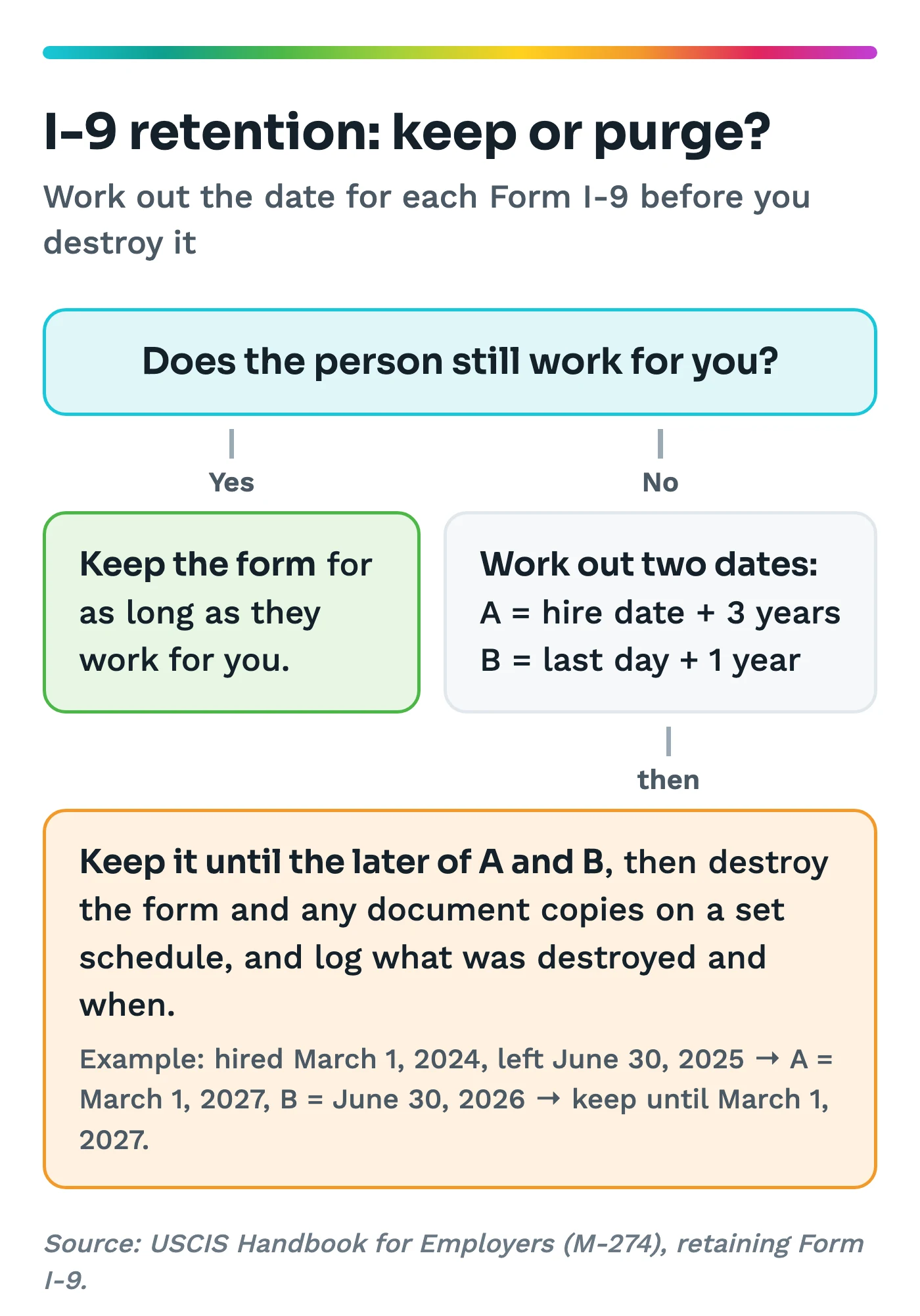
| Employee situation | Keep the form until | Example |
|---|---|---|
| Still employed | Indefinitely, while they work for you | Hired 2012, still on payroll: keep |
| Left within 2 years of hire | 3 years after the hire date | Hired March 1, 2024, left June 30, 2025: keep until March 1, 2027 |
| Left after more than 2 years | 1 year after the last day of work | Hired 2018, left May 15, 2026: keep until May 15, 2027 |
Purging forms that are past their retention date is part of the audit. A form you no longer have to keep can still show violations if ICE sees it. Destroy expired forms and their document copies on a set schedule, and keep a record of what was destroyed and when.
How do you correct I-9 errors the right way?
USCIS sets the method in M-274 Section 9.0. The basic rule is to show the change, never hide it.
- Section 1 errors: Only the employee, or their preparer or translator, can fix Section 1. They draw a line through the wrong entry, write the correct information, and initial and date the change.
- Section 2 and Supplement B errors: The employer or its authorized representative uses the same method: line through, correct entry, initials and today’s date.
- Several errors in one section: Complete that section again on a new Form I-9 and attach it to the original.
- Missing dates: Don’t backdate. Enter the current date and initial next to it.
- Missing Form I-9: Complete a new form on the current edition now. Enter the actual first day of employment and sign with today’s date. Attach a signed, dated note explaining the gap.
- No correction fluid or erasing: If someone already used correction fluid, attach a signed and dated note explaining what happened.
- Electronic forms: The system’s audit trail must record every correction and addition.
Attach a short memo to each corrected form saying what was wrong, what changed and why. Don’t terminate anyone because of an audit finding unless they can’t show identity and work authorization after a fair chance to do so.
I-9 audit log template
The audit log is your proof that the audit was even-handed and that corrections were made in good faith. Keep it separate from personnel files, use employee ID numbers rather than full names where you can, and limit who can see it.
| Employee ID | Hire date | Issue found | Correction made | Date corrected | Auditor |
|---|---|---|---|---|---|
| 10482 | 04/14/2025 | Section 2 first day of employment blank | Date entered, initialed and dated; memo attached | 11/12/2026 | J. Rivera, HR |
| 10517 | 08/02/2025 | Section 1 not dated by employee | Employee dated the attestation with today’s date and initialed; memo attached | 11/13/2026 | J. Rivera, HR |
| 10533 | 09/22/2025 | No Form I-9 on file | New current-edition form completed; actual hire date entered; memo attached | 11/13/2026 | Outside counsel |
What changed for I-9 audits in 2026?
Form I-9 2026: which edition to use
The current edition is dated 01/20/25. The USCIS Form I-9 page also accepts the 08/01/23 edition with a 05/31/2027 expiration date. The other 08/01/23 version, which expires 07/31/2026, can no longer be used. Employers with electronic I-9 systems had to update to the 05/31/2027 version by July 31, 2026. If your vendor or in-house system still produces the July 2026 version, fix that first.
You don’t need to redo forms just because a newer edition came out. ICE checks whether the version you used was current when the form was first completed.
ICE’s new inspection fact sheet
According to employment law firms, ICE issued a new inspection fact sheet in March 2026 that replaced its decades-old guidance on technical and substantive violations. The version on ICE’s website now shows an update date of August 31, 2026. Firms such as Ogletree report that the change moved several errors from “technical” to “substantive.” Those include a missing employee date in Section 1, a missing employer name and title, hire date or certification date in Section 2, an incomplete Supplement A, and a missing rehire date in Supplement B.
The fact sheet now also lists these as substantive:
- Completing a Spanish-language form outside Puerto Rico.
- Failing to meet the electronic I-9 standards in 8 CFR 274a.2(e)–(i).
- Checking the alternative procedure box without being an active E-Verify participant or registered in a DHS remote examination program.
Only a short list of technical failures remains. It includes a missing physical address or other last names in Section 1, and a missing employee name at the top of later pages. Technical failures are not fined if you fix them within the correction period, which is at least ten business days. A missing email address or phone number in Section 1 is not a violation at all. Read the ICE page itself rather than a summary, because firm write-ups differ on the details.
E-Verify Status Change Report
E-Verify employers have an extra step. The Status Change Report (Reports tab, launched June 20, 2025) lists cases where DHS later revoked the employee’s EAD. Later updates added TPS- and asylum-related EADs. Check it during the audit. For each current employee listed whose EAD number matches, reverify in Supplement B using an unexpired List A or List C document, and don’t create a new E-Verify case. The guide to the E-Verify Status Change Report walks through each step.
What can an ICE I-9 audit cost in 2026?
Civil fines are set in 8 CFR 274a.10. The current amounts come from the DHS January 2, 2025 inflation adjustment and apply to penalties assessed after that date for violations after November 2, 2015. There is no 2026 increase. OMB Memorandum M-26-11 cancelled the 2026 inflation adjustments government-wide, and eCFR shows no later change to the DHS amounts. The guide to I-9 penalties in 2026 explains which errors now count as substantive.
| Violation or outcome | Civil penalty or consequence |
|---|---|
| Paperwork violation (substantive, or uncorrected technical) | $288 to $2,861 per Form I-9 |
| Knowingly hiring or continuing to employ unauthorized workers, first offense | $716 to $5,724 per unauthorized worker |
| Knowing hire or continuing to employ, second offense | $5,724 to $14,308 per unauthorized worker |
| Knowing hire or continuing to employ, third or later offense | $8,586 to $28,619 per unauthorized worker |
| Technical or procedural failure found by ICE | Notice of Technical or Procedural Failures; at least 10 business days to correct before it counts as substantive |
| Substantive violations with expected future compliance | Warning Notice instead of a fine (ICE’s discretion) |
| Fine proposed | Notice of Intent to Fine; 30 calendar days to request a hearing |
| Knowing hire or continuing-to-employ violations | Possible debarment, per ICE’s fact sheet |
ICE sets the paperwork fine within the range using five factors: business size, good faith, seriousness of the violation, whether unauthorized workers were involved, and history of violations. Each factor can move the base fine up or down by 5%, up to a total of 25%. A documented audit and a clean audit log support the good-faith factor.
What to do now
- Confirm your blank forms and electronic I-9 system use the 01/20/25 edition or the 08/01/23 version that expires 05/31/2027.
- Write a one-page audit plan covering scope, neutral sampling method, who audits, employee notice and timeline, and keep it with the audit log.
- Run the roster match, then check every form in scope against the checklist above, starting with the items ICE now calls substantive.
- Correct errors using the USCIS method, attach a memo to each corrected form, and record each change in the audit log.
- Purge forms past their retention date, and log what was destroyed.
- Train everyone who completes Section 2 on the three-business-day rule and the 2026 fact sheet, and schedule the next audit, usually within 12 months.
For a live walkthrough of these steps with an immigration compliance expert, see the webinar I-9 Audits: Strengthening Your Immigration Compliance Strategies in 2026. Supervisors who complete Section 2 need training too: see HR compliance training for managers. More sessions are listed under HR compliance webinars.
Frequently asked questions
What is an I-9 audit?
An I-9 audit is a review of an employer’s Forms I-9 for missing forms, late or incomplete sections and other errors. Employers run internal self-audits voluntarily. ICE runs Form I-9 inspections after serving a Notice of Inspection, and the employer then has at least three business days to produce the forms.
How long does an employer have to respond to an ICE I-9 audit?
ICE gives employers at least three business days after serving a Notice of Inspection to produce the Forms I-9 it requests. ICE may also ask for payroll records, employee lists and business documents. If ICE later finds technical or procedural failures, you get at least ten business days to correct them.
What triggers an I-9 audit?
ICE does not publish how it selects employers for a Form I-9 inspection. Its fact sheet says only that an inspection starts when ICE serves a Notice of Inspection, and that employers that receive a Warning Notice may get a follow-up NOI later. Since any employer can receive an NOI, audit before one arrives.
Can I fix I-9 mistakes I find during a self-audit?
Yes. The employee corrects Section 1, and the employer corrects Section 2 and Supplement B. Draw a line through the error, enter the right information, initial and date it with the current date, and attach a note explaining the change. Never backdate, erase or use correction fluid.
What are the fines for I-9 paperwork violations in 2026?
Paperwork violations carry civil fines of $288 to $2,861 per Form I-9 under 8 CFR 274a.10, as adjusted by DHS on January 2, 2025. There was no 2026 inflation increase because OMB cancelled the 2026 adjustments government-wide. Knowingly hiring unauthorized workers carries higher per-worker fines.
What should I do if an employee’s Form I-9 is missing?
Have the employee complete Section 1 and complete Section 2 yourself on the current edition now, with today’s signature dates. Enter the actual first day of employment and attach a signed, dated memo explaining why the form was missing. Do not backdate the form.
How often should employers do an I-9 audit?
No law requires an internal audit or sets a schedule, and an audit does not protect you from fines for violations it misses. Many employers audit once a year, and also after a form edition change, an E-Verify enrollment, an acquisition or a change in HR staff. Smaller monthly checks of new-hire forms catch timing errors before they pile up.
How long do you have to keep Form I-9?
For as long as the person works for you. After they leave, keep the form until three years after the date of hire or one year after employment ends, whichever is later, then destroy it and its document copies on a set schedule.
Run your I-9 audit with an expert
The I-9 audits webinar walks through the self-audit, corrections and the 2026 ICE fact sheet. Choose Whole team so HR and every Section 2 reviewer can attend and get the recording.
See the I-9 audits webinar247Compliance app
HR teams can attend the I-9 audits webinar live or watch the recording later in the 247Compliance app. The completion certificate is saved in the app, so you can file it with your audit records as proof of training.
Get the appSources (14)
- ICE: Form I-9 Inspection Under INA § 274A (fact sheet, updated 08/31/2026)
- USCIS: I-9, Employment Eligibility Verification (current editions)
- USCIS I-9 Central: Self-Audits and Correcting Mistakes
- USCIS M-274, 9.0 Correcting Errors or Missing Information on Form I-9
- USCIS I-9 Central: Correcting Form I-9
- USCIS M-274, 10.0 Retaining Form I-9
- USCIS I-9 Central: Remote Examination of Documents
- DOJ IER and ICE: Guidance for Employers Conducting Internal Form I-9 Audits
- Federal Register: DHS Civil Monetary Penalty Adjustments for Inflation (Jan. 2, 2025, 90 FR 1)
- Federal Register: DOJ notice referencing OMB M-26-11 cancellation of 2026 penalty inflation adjustments (July 15, 2026)
- eCFR: 8 CFR 274a.10 version history (last amended Jan. 2, 2025)
- E-Verify: New Status Change Report for E-Verify Users
- E-Verify: Status Change Report Now Includes TPS and Asylum-related EADs
- Ogletree: ICE Issues New Fact Sheet on I-9 Violation Classifications (Apr. 21, 2026; secondary source for March 2026 reclassification details)
This article is general information, not legal or tax advice. Check the official sources above or consult a qualified advisor for your situation.
 LIVE WEBINAR · 23 NOV · 10:00 AM PT · 1:00 PM ET
Managing Toxic Employees: Strategies For Leaders To Effectively Deal With Employee Attitude Issues
Beverly Beuermann-King · 60 min · from $179
Enroll