

Key points
- No federal law sets investigation steps or a deadline, but for supervisor harassment that ends in no tangible employment action, proving you acted with reasonable care to prevent and promptly correct it is one of the two elements of the employer’s defense.
- As of November 2026 the EEOC has no current harassment enforcement guidance: it rescinded the 2024 guidance on January 22, 2026, and its 1999 guidance is still posted but marked superseded.
- Decide each allegation on the preponderance of the evidence (more likely than not), state factual rather than legal findings, and take preventive steps even when the result is inconclusive.
- Confidentiality orders to non-supervisory employees are limited by the NLRA’s Stericycle standard, still Board law as of November 2026; in California, outside investigators must be licensed private investigators or attorneys.
- Keep investigation records at least one year under 29 CFR 1602.14, and until final disposition once an EEOC charge is filed; check for any legal hold before destroying a file.
To conduct a workplace investigation, HR records the complaint, decides whether it needs a formal inquiry, protects people and evidence, interviews the complainant, the accused employee and witnesses, weighs the evidence and writes a report that management acts on. Done promptly and impartially, the investigation is also the employer’s proof that it used “reasonable care” to correct harassment, the first element of the defense the Supreme Court set out in 1998. This guide follows federal law as of November 2026, notes California rules where they add requirements, and ends with a report outline you can reuse.
HR investigation process, step by step
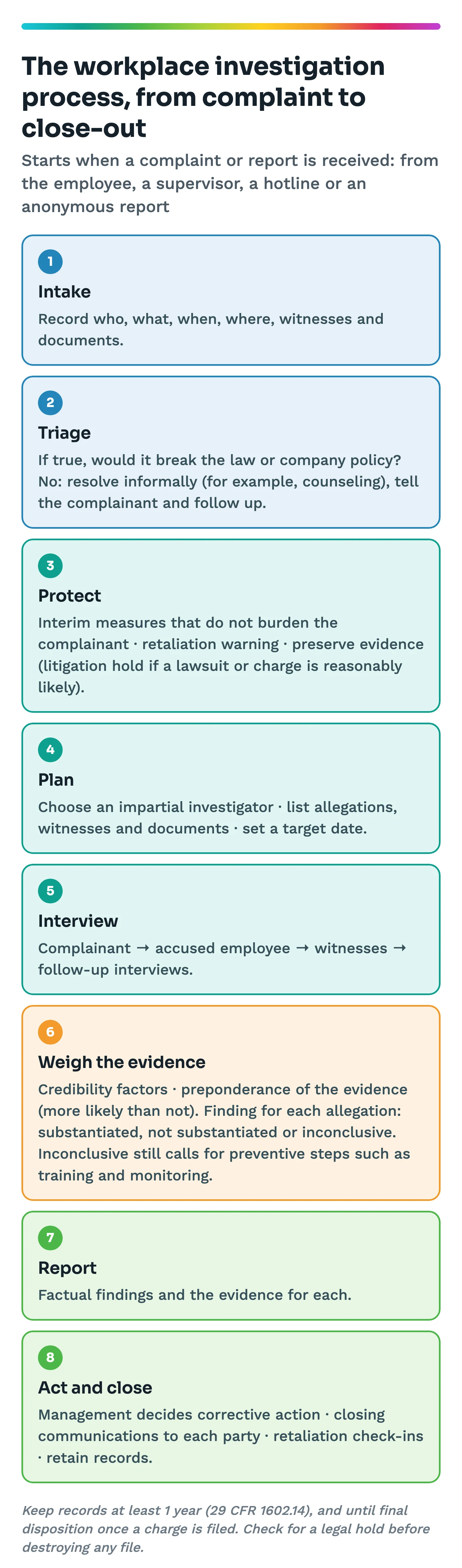
No federal statute or regulation prescribes investigation steps. Title VII of the Civil Rights Act (employers with 15 or more employees) bars retaliation against anyone who opposed a practice it makes unlawful or “participated in any manner in an investigation, proceeding, or hearing” under it (42 U.S.C. 2000e-3(a)), and the Supreme Court has held that an employee who reports harassment while answering questions in an employer’s internal investigation is protected (Crawford v. Metropolitan Government of Nashville, 2009). The sequence below follows the Supreme Court’s liability rules, EEOC materials and the California Civil Rights Department’s Harassment Prevention Guide for Employers (March 2025).
Eight steps from complaint to close-out
Use this tracker to assign each step on a live case; each step should leave a dated record in the file.
| Step | What to do | Record to keep |
|---|---|---|
| 1. Intake | Record the complaint in the complainant’s words: who, what, when, where, witnesses, documents. Supervisors who hear a complaint pass it to HR at once. | Dated complaint note or written complaint |
| 2. Triage | Ask whether the conduct, if true, would break the law or your policy. If so, California’s guide says the employer must investigate; a minor matter may be resolved by counseling. | Decision note and reasons |
| 3. Protect | Interim measures, retaliation warnings, evidence preservation | Interim measures note, preservation notice |
| 4. Plan | Choose an impartial investigator; list allegations, witnesses and documents; set a target date | Investigation plan |
| 5. Interview | Complainant, then the accused employee, then witnesses; follow up when evidence conflicts | Interview notes, any signed statements |
| 6. Weigh the evidence | Assess credibility; decide each allegation on the preponderance of the evidence | Credibility analysis |
| 7. Report | Write factual findings with the evidence behind each one | Signed, dated report |
| 8. Act and close | Management decides corrective action; tell each party the outcome; check for retaliation; file the records | Decision note, closing letters, follow-up notes |
A complaint can carry a second process with it: if the employee is also asking for a change at work because of a medical condition, start the ADA interactive process alongside the investigation.
Why the process matters: the Faragher/Ellerth defense
When a supervisor’s harassment creates a hostile work environment but does not end in a tangible employment action, the employer can avoid liability by proving two things: that it “exercised reasonable care to prevent and correct promptly” harassing behavior, and that the employee unreasonably failed to use the preventive or corrective opportunities it offered (Faragher v. City of Boca Raton and Burlington Industries v. Ellerth, both decided June 26, 1998). No such defense exists when the harassment ends in a tangible action such as discharge or demotion. For harassment by coworkers or non-employees, the EEOC says the employer is liable if it knew or should have known and “failed to take prompt and appropriate corrective action.” A prompt, documented investigation is your evidence in both cases. Publish the complaint procedure in the handbook; state law also sets some employee handbook requirements.
Where EEOC guidance stands in November 2026
On January 22, 2026, the EEOC voted 2–1 to rescind its 2024 Enforcement Guidance on Harassment in the Workplace, and it has announced no replacement. Its 1999 guidance on vicarious liability, which contains investigation advice and sample interview questions, is still posted with a note that it was superseded on April 29, 2024; the EEOC has not said it is back in force. The statutes and Supreme Court decisions are unchanged, and points below taken from the 1999 document are labeled as such.
Who should conduct a workplace investigation?
The investigator must be impartial, trained in interviewing and weighing credibility, and senior enough to be taken seriously. The EEOC’s 1999 guidance adds that the accused person should have no supervisory authority over the investigator and no control over the investigation; California’s guide says it is generally a bad idea for the investigator to have less authority than the complainant or the accused.
Internal HR vs outside investigator
| Investigator | Consider when | Watch for |
|---|---|---|
| HR employee | Most policy complaints, where HR is independent of the people involved | Friendship with a party, reporting to the accused, earlier involvement in the dispute |
| Outside investigator | Allegations against senior leaders or HR, several complainants, or high legal risk | State licensing rules; the FCRA notice after adverse action; a written scope |
| Attorney | Litigation is likely or the company needs legal advice on the findings | Privilege rules; an attorney who investigates may later be a witness |
In California, external investigators “must be licensed private investigators or attorneys acting in their capacity as an attorney,” the Civil Rights Department says, citing Business and Professions Code section 7520 and following; employees investigating for their own employer are not external investigators. Other states have their own licensing laws; check before hiring.
An outside investigator’s report can also touch the Fair Credit Reporting Act (FCRA). Communications to an employer about suspected misconduct, or compliance with laws, regulations or preexisting written policies, are not consumer reports if they are not made to investigate creditworthiness and are shared only with the employer, its agents, government bodies or the few others the statute lists. If you take adverse action based even partly on one, you must give the employee a summary of the “nature and substance” of the communication, although sources of information gathered solely for the investigation need not be disclosed (15 U.S.C. 1681a(y)).
Using an attorney and protecting privilege
In Upjohn Co. v. United States (1981), the Supreme Court held that employees’ communications with company counsel, made at management’s direction so counsel can advise the company, can be privileged; the privilege “extends only to communications and not to facts.” Lawyers open such interviews with what is called an Upjohn warning: counsel represents the company, not the employee, and the company alone decides whether to waive the privilege and disclose what was said. If you later rely on the investigation to prove reasonable care, expect to disclose it; decide with counsel at the start which you are doing.
Avoiding conflicts and bias
Before assigning the case, ask the proposed investigator whether they have supervised, reported to or socialized with either party, sit in either party’s chain of command, or handled an earlier complaint involving them. California’s guide treats a reasonable perception of bias as a reason to step aside, even if the investigator could be neutral.
Planning the workplace investigation process
Scope and allegations list
Turn the complaint into numbered factual questions, one per allegation: “Did the shift lead send the complainant the text messages dated March 3?” rather than “Was there harassment?” Next to each, list who may know and which documents could confirm or contradict it. California’s guide says you need not interview every witness a party suggests, only those who “could reasonably confirm or undermine” the allegations or the response, so record why you left any out.
Interim measures and retaliation warnings
Decide what changes while the investigation runs: separate schedules or work areas, a different reporting line, or paid leave for the accused employee where allegations are serious. The EEOC’s 1999 guidance says the complainant “should not be involuntarily transferred or otherwise burdened.” Tell everyone involved that retaliation is prohibited and how to report it. Teaching supervisors to spot and avoid it is part of HR compliance training for managers.
Preserving documents and electronic evidence
List the evidence that could disappear (email, chat and text messages, video, badge and timekeeping records, personal-phone messages) and ask IT to suspend automatic deletion for the accounts involved. If a lawsuit or charge is reasonably likely, issue a written litigation hold; under Federal Rule of Civil Procedure 37(e), a court can act if electronically stored information “that should have been preserved in the anticipation or conduct of litigation” is lost because a party failed to take reasonable steps to preserve it and it cannot be restored or replaced through additional discovery.
Confidentiality instructions and labor-law limits
You can promise only limited confidentiality: information goes to people who need it, such as witnesses, HR and the decision-maker. Ordering employees not to discuss an investigation is harder. Section 7 of the National Labor Relations Act (NLRA) protects non-supervisory private-sector employees, union or not, who discuss working conditions. Under Stericycle, Inc. (372 NLRB No. 113, August 2, 2023), a work rule that could reasonably chill those rights is presumed unlawful unless the employer proves it advances a legitimate and substantial business interest that a narrower rule could not; the decision overruled Apogee Retail (2019), which had allowed confidentiality rules for open investigations. As of November 2026 Stericycle had not been overruled, but the NLRB General Counsel has asked the Board to overrule it (memo GC 26-04, August 26, 2026), so check the current standard before you issue the instruction; California’s guide tells employers to consult an attorney before requiring confidentiality. Supervisors fall outside the NLRA’s definition of employee (29 U.S.C. 152(3)).
How to conduct a workplace investigation interview
Interview the complainant first. Give the accused employee the allegations during the interview, not before, and a full chance to respond: California’s guide says the accused is entitled to know the allegations but not necessarily who made them, and need not be shown the written complaint. Use open-ended questions; the same guide says investigations “should not be interrogations.” Document each interview the same way, and keep handwritten notes even after typing them up. The question sets below adapt the sample questions in the EEOC’s 1999 guidance.
Questions for the complainant
- Who did it, what exactly was said or done, when and where, how often, and is it still happening?
- How did you respond at the time, and afterward?
- Who was present, who did you tell, and did anyone see you right after it happened?
- Do you have notes, messages, photos or other records?
- How has this affected you or your job, and how would you like it resolved?
Questions for the accused employee
- What is your response to each allegation? (Put them one at a time, with dates and specifics.)
- If you say an allegation is false, why might the complainant be mistaken or untruthful?
- Who else has relevant information, and what records exist (messages, calendars, logs)?
End by repeating that retaliation against the complainant or any witness is prohibited.
Questions for witnesses
- What did you see or hear, and when? Did you see it yourself or hear about it later?
- How does the accused employee behave toward the complainant and toward others?
- What did the complainant tell you, and when?
- Who else might know, and do you have any messages or notes?
Union representation and recording rules
Where a union represents the employee, the employee may ask for a union representative at an investigatory interview they reasonably believe could lead to discipline (NLRB v. J. Weingarten, Inc., 1975). The right arises only on request; you need not bargain with the representative, and if you refuse, you may carry on the inquiry without interviewing that employee. Under current Board law only union-represented employees have this right: the NLRB extended it to non-union employees in Epilepsy Foundation of Northeast Ohio (2000) and withdrew it in IBM Corp. (2004). Because the Board has changed its view before, check current Board law, your own policy and any state rule before refusing a non-union request.
California’s guide says recording is not necessary unless your policy or a union agreement requires it. Federal law lets one party consent to recording a conversation, unless it is made for a criminal or tortious purpose (18 U.S.C. 2511(2)(d)), but California requires all parties’ consent to record a confidential communication (Penal Code section 632), as do some other states. If anyone records, get everyone’s consent on the recording.
Weighing evidence and reaching findings
Credibility factors
When accounts conflict, look first for evidence that does not depend on either party: documents, messages, logs and what people said to others at the time. Then weigh each account against these factors from California’s guide:
- Inherent plausibility: does the story hold together?
- Motive to lie
- Corroboration by a witness or record
- Ability to perceive and recall what is described
- Known history of honesty or dishonesty
- Habit and consistency with known behavior
- Inconsistent statements not easily explained
- Demeanor, used with caution, since most people cannot judge truthfulness from it
The EEOC’s 1999 guidance lists five of these factors and says none is decisive on its own.
The preponderance of the evidence standard
Decide each allegation on whether it is more likely than not that it happened, the preponderance of the evidence standard civil courts use in discrimination and harassment cases; California’s guide warns that “clear and convincing” or “beyond a reasonable doubt” sets an unrealistic bar. Record one finding per allegation, for example substantiated, not substantiated or inconclusive. Findings are factual: the investigator decides what happened, not whether it was illegal, and whether it broke policy is usually the employer’s call. If the result is inconclusive, the EEOC’s 1999 guidance says to still take preventive steps such as training and monitoring.
Workplace investigation report template
No law prescribes a report format. The report should let a reader who was not involved see what was alleged, what the investigator did, what the evidence showed and why each finding was reached. Chad V. Sorenson’s recorded internal investigations webinar covers what to include in the final report and what to tell the complaining employee afterward.
Report template, section by section
| Report section | What to include | Mistake to avoid |
|---|---|---|
| 1. Cover details | Case number, date, investigator, who commissioned the report, confidentiality or privilege label agreed with counsel | A privilege label on a report you will later rely on as proof of reasonable care |
| 2. Complaint and allegations | How and when the complaint arrived; each allegation as a numbered factual question | Restating the complaint as a legal conclusion (“hostile work environment”) |
| 3. Scope and method | What the investigation covered, people interviewed with dates, documents reviewed, requests declined and why | Leaving out witnesses suggested by a party without explaining why |
| 4. Interim measures | What changed during the investigation and when | Measures that moved or disadvantaged the complainant |
| 5. Relevant policies | Policy names, versions and the exact provisions at issue | Quoting a policy version that was not in force at the time |
| 6. Evidence summary | What each witness and document said about each allegation | Mixing the investigator’s opinions into witness summaries |
| 7. Credibility analysis | Which accounts were credited on disputed points, and why, using the factors | Relying on demeanor alone, or on rank or reputation |
| 8. Findings | For each allegation: substantiated, not substantiated or inconclusive, on the preponderance of the evidence | Legal conclusions (“unlawful harassment occurred”) |
| 9. Policy conclusions (if asked) | Whether substantiated conduct broke a named policy | Outside investigators deciding discipline |
| 10. Attachments and sign-off | Statements, exhibits, evidence log, investigator signature and date | Missing source documents for a finding |
Workplace investigation report example (hypothetical excerpt)
The excerpt below is invented to show the format; it does not describe a real case.
Allegation 2: On May 12, 2026, during the weekly team meeting, the regional manager told the complainant that her plan was “useless” and that she “should stick to admin work.”
Evidence: The complainant described both remarks; the manager denied the second and said he called the plan “not workable.” Witness A recalled “useless”; Witness B recalled both remarks. An email the complainant sent a colleague at 1:14 p.m. that day describes both remarks.
Analysis: Neither witness reports to either party. The email, written within two hours, matches the complaint, and both witnesses contradict the manager on the first remark.
Finding: Substantiated. A preponderance of the evidence supports the conclusion that the regional manager made both remarks at the May 12 meeting.
How long does an HR investigation take?
No federal law sets a deadline in days. The test is promptness: the Faragher/Ellerth defense turns on correcting harassment “promptly,” and the EEOC’s 1999 guidance says an investigation “should be launched immediately.” California’s guide describes how some employers set internal targets: same-day action on allegations of physical harassment or threats of violence, and, for less urgent complaints, contacting the complainant within a day or two and aiming to finish within a few weeks, depending on witness availability.
What drives the timeline
The number of allegations and witnesses, witness availability (leave, shifts, remote staff), the volume of electronic evidence, engaging an outside investigator, union involvement and new allegations raised in interviews.
Keeping parties updated
Tell the complainant and the accused employee when you expect to finish, update them if the date moves, and record the reason for any delay in the file.
After the investigation: corrective action and next steps
Closing communications to each party
Close the case in writing. Tell the complainant that the investigation is complete, whether the allegations were substantiated, that appropriate action has been taken where it was, and to report any retaliation. Tell the accused employee the findings and any action; California’s guide says fairness requires telling the accused the nature of the complaint before disciplining them. Remind witnesses that retaliation is prohibited, and decide with counsel how much detail about discipline to share.
Corrective action and follow-up checks for retaliation
California’s guide says remedial action should be proportionate and stop the conduct recurring, consistent with what you did in similar past cases; options run from training and counseling to demotion and termination. It also recommends checking back with the complainant after the investigation, whatever the outcome, because retaliation can come later. Put dated check-ins on the calendar and record what you learn. If the remedy includes training, check the harassment training requirements in your state.
Record retention
Under 29 CFR 1602.14, employers covered by Title VII, the ADA or GINA must keep personnel records for one year from the date the record was made or the personnel action was taken, whichever is later, and for one year after an involuntary termination. Once a charge is filed or the EEOC or Attorney General brings an action, keep all relevant personnel records until final disposition. Those are minimums, and state rules can be longer: California requires employers to keep personnel records and files for four years (Government Code section 12946), and a complaint to its Civil Rights Department can be filed within three years, so set your retention period with that in mind. Before you destroy any investigation file, confirm there is no open charge, lawsuit, demand letter or legal hold.
What to do now
- Check that your complaint procedure names more than one person employees can go to and requires supervisors to pass complaints to HR at once.
- Train your internal investigators and line up an outside investigator or counsel (licensed where required) before you need one.
- Use the eight-step tracker and report outline above as the standard file structure.
- Check the confidentiality and recording language in your investigation notices against current NLRA law.
- Add a legal-hold check to your retention schedule before any investigation file can be destroyed.
- Brief managers on taking complaints and avoiding retaliation; more sessions are listed on the HR compliance webinars page.
Frequently asked questions
What are the steps of a workplace investigation?
A workplace investigation usually runs through eight steps: intake, triage, interim protection and evidence preservation, planning, interviews, weighing the evidence, a written report, and corrective action with close-out. No federal law fixes the steps, but courts judge whether the employer acted promptly and reasonably, so each step should leave a dated record in the file.
Who should conduct a workplace investigation?
Someone impartial, trained in interviewing and assessing credibility, with no reporting line to the accused employee and no part in the dispute: often HR, or an outside investigator or attorney for complaints against senior leaders or HR itself. In California, an investigator who is not the employer’s own employee must be a licensed private investigator or an attorney acting as an attorney.
How long does an HR investigation take?
No federal law sets a deadline; the standard is promptness, and the EEOC’s 1999 guidance says an investigation should be launched immediately. California’s Civil Rights Department describes employers acting the same day on threats or physical harassment and aiming to finish less urgent cases within a few weeks, depending on witnesses and evidence. Record the reason for any delay.
What goes in a workplace investigation report?
Cover details, the allegations as numbered factual questions, the scope and method (who was interviewed and what was reviewed), interim measures, the relevant policies, an evidence summary, a credibility analysis, a finding on each allegation under the preponderance of the evidence standard, and attachments with the investigator’s signature. Findings should state what happened, not whether the law was broken.
Can an employer require employees to keep an investigation confidential?
Only within limits. Under the NLRB’s Stericycle decision (2023), which had not been overruled as of November 2026 (the NLRB General Counsel has asked the Board to do so), a confidentiality rule that could reasonably chill non-supervisory private-sector employees’ right to discuss working conditions is presumed unlawful unless the employer shows a legitimate and substantial interest that a narrower rule could not protect. Supervisors are not covered by the NLRA, and California’s guide advises asking an attorney before requiring confidentiality.
Can an employee bring someone to an investigation interview?
An employee represented by a union can ask for a union representative at an investigatory interview they reasonably believe could lead to discipline (NLRB v. J. Weingarten, 1975). The employee must ask; the employer may then allow it, end the interview and decide on other evidence, or let the employee choose between continuing without a representative and ending the interview. Under current Board law (IBM Corp., 2004) non-union employees do not have this right, but the Board has changed its view before, so check current Board law, your own policy and any state rule before refusing a non-union employee’s request.
Run every investigation the same defensible way
Chad V. Sorenson’s recorded 90-minute session covers the steps to a fair internal investigation, a timeline for responding to a complaint, what to include in the final report and what to tell the complaining employee afterward.
Watch the recorded webinarSources (22)
- Faragher v. City of Boca Raton, 524 U.S. 775 (June 26, 1998): employer affirmative defense
- Burlington Industries, Inc. v. Ellerth, 524 U.S. 742 (June 26, 1998)
- EEOC: Harassment (employer liability and corrective action)
- EEOC press release (January 23, 2026): Commission votes to rescind 2024 harassment guidance
- EEOC: Enforcement Guidance on Vicarious Employer Liability for Unlawful Harassment by Supervisors (June 18, 1999; marked superseded April 29, 2024), section V.C.1 investigation
- California Civil Rights Department: Harassment Prevention Guide for Employers (March 2025), investigation sections, pages 4–14
- 42 U.S.C. 2000e-3(a): Title VII retaliation (opposition and participation clauses)
- Crawford v. Metropolitan Government of Nashville, 555 U.S. 271 (January 26, 2009): answering questions in an internal investigation is protected opposition
- 42 U.S.C. 2000e(b): Title VII definition of employer (15 or more employees)
- 15 U.S.C. 1681a(y): FCRA exclusion for employee misconduct investigations; summary after adverse action
- Upjohn Co. v. United States, 449 U.S. 383 (January 13, 1981): attorney-client privilege for employee interviews
- NLRB v. J. Weingarten, Inc., 420 U.S. 251 (February 19, 1975): union representation at investigatory interviews
- NLRB: Weingarten Rights (current Board law: only union-represented employees have the right)
- NLRB: Board adopts new standard for assessing lawfulness of work rules (Stericycle, Inc., 372 NLRB No. 113, August 2, 2023)
- NLRB General Counsel memo GC 26-04, Further Guidance Regarding General Counsel Priorities (August 26, 2026): asks the Board to overturn Stericycle in Honeywell International Inc.
- 29 U.S.C. 152(3): NLRA definition of employee (excludes supervisors)
- Federal Rules of Civil Procedure, Rule 37(e): failure to preserve electronically stored information
- 18 U.S.C. 2511(2)(d): one-party consent to record (federal)
- California Penal Code section 632: recording confidential communications without consent of all parties
- California Business and Professions Code sections 7520–7522: private investigator licensing and exemptions (employees of the employer; attorneys)
- eCFR: 29 CFR 1602.14 Preservation of records made or kept
- California Government Code section 12946: four-year retention of personnel records and files
This article is general information, not legal or tax advice. Check the official sources above or consult a qualified advisor for your situation.
How we research, check and correct articles: editorial policy. Spotted an error? Tell us.
 LIVE WEBINAR · 1 DEC · 10:00 AM PT · 1:00 PM ET
Your AI Advantage: How HR Professionals Can Use Claude to Stay Compliant, Save Time, and Work Smarter
Margie Faulk · 90 min · from $179
Enroll