

Key points
- There is no single contractor vs employee test: the IRS uses common-law control, the DOL uses economic reality under the FLSA, and many states use a stricter ABC test.
- The DOL’s final rule (91 FR 75646) was published November 23, 2026, and takes effect January 22, 2027, with two core factors: control and opportunity for profit or loss.
- Until then the 2024 rule remains in effect for private lawsuits, where courts decide how much weight to give it, but DOL investigators use the 2008 Fact Sheet #13 factors under FAB 2025-1.
- Misclassification can mean back employment taxes under IRC section 3509, FLSA back wages plus equal liquidated damages, and state penalties.
- Businesses that qualify can reclassify workers through the IRS Voluntary Classification Settlement Program and pay 10% of one year’s section 3509(a) liability.
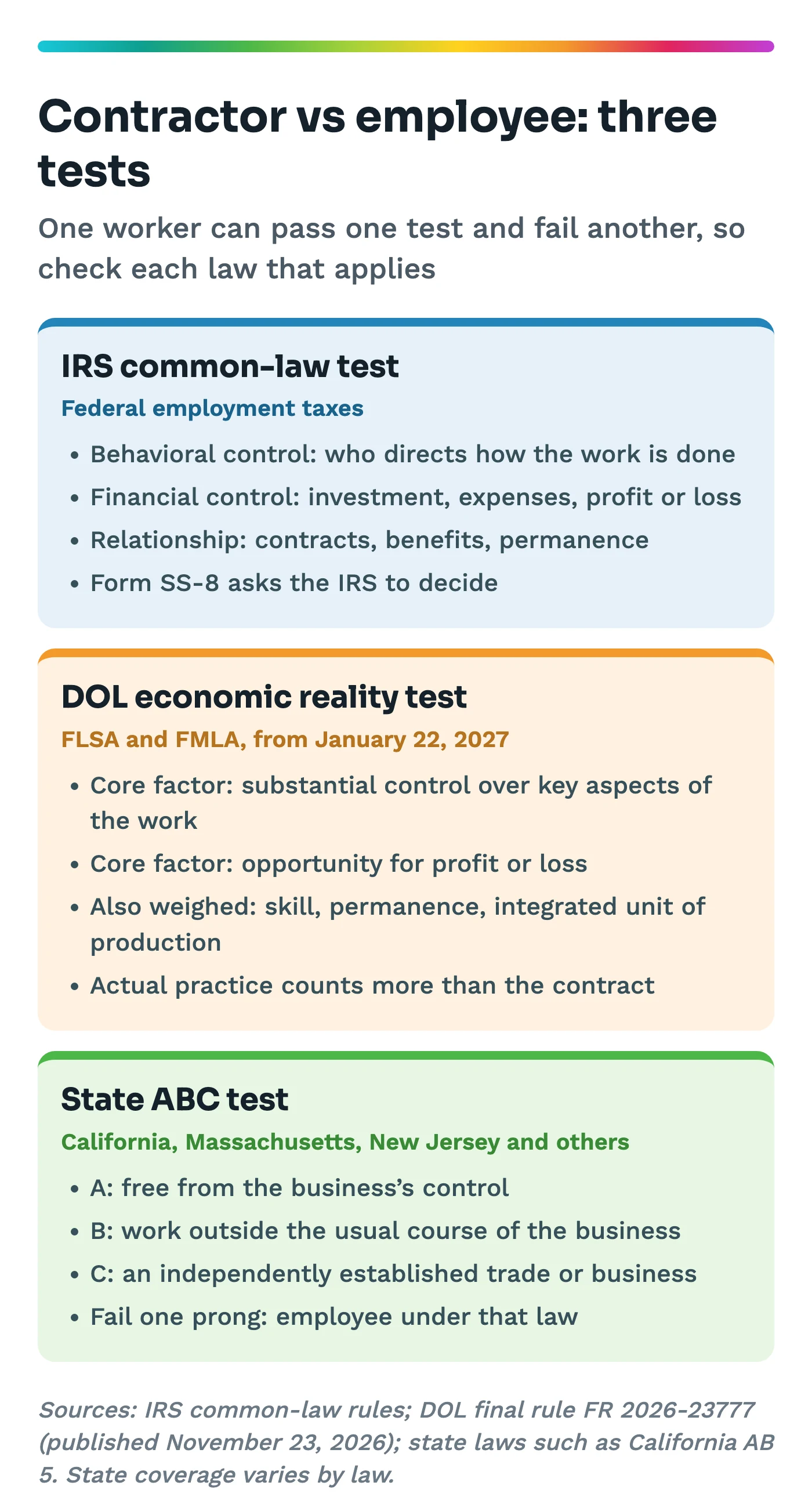
Contractor vs employee status is decided by more than one legal test, and a worker can pass one and fail another. The IRS applies the common-law control test for federal employment taxes. The Department of Labor applies an “economic reality” test under the Fair Labor Standards Act (FLSA), and its final rule, published November 23, 2026, takes effect January 22, 2027. Many states add a stricter ABC test. This guide compares each independent contractor vs employee test as of November 24, 2026.
Contractor vs employee: which test applies?
Each law defines “employee” for its own purposes, so the real question is “contractor or employee under which law?” The contract label and the form you issue at year end do not decide it; the facts of the working relationship do.
| Test | Who uses it | Laws it applies to | Core question | Status as of November 2026 |
|---|---|---|---|---|
| Common-law control test | IRS | Federal income tax withholding, FICA and FUTA | Does the business have the right to control what is done and how it is done? | No change |
| Economic reality test | DOL Wage and Hour Division, federal courts | FLSA minimum wage, overtime and recordkeeping; FMLA and MSPA also use it under the new rule | Is the worker economically dependent on the business for work, or in business for themselves? | 2024 rule until the final rule takes effect January 22, 2027; DOL investigators stopped applying it in May 2025 |
| ABC test | Several states, such as California, Massachusetts and New Jersey | Varies by state: wage and hour law, unemployment insurance, sometimes workers’ compensation | Can the business prove all three prongs? | California since 2018 for wage orders and 2020 for the Labor Code and unemployment insurance; New Jersey’s new ABC rules operative October 1, 2026 |
Classification errors surface at year end, when you decide who gets a Form W-2 and who gets a Form 1099-NEC, which is why worker status is a line on the year-end payroll checklist.
Can a worker be a contractor for the IRS but an employee under the FLSA?
Yes. The FLSA defines “employ” as “to suffer or permit to work,” which courts read more broadly than the common-law test the IRS uses. State law adds another layer: the FLSA does not preempt state wage laws that protect workers more (29 U.S.C. 218(a)), and state ABC tests apply on their own terms.
For example, a freelance designer with her own studio, equipment and several clients may be a contractor under the IRS factors. If she designs campaigns for a Massachusetts marketing agency, the agency will struggle with prong B of the state’s ABC test, because design is inside its usual course of business. Treat the strictest test that applies as your working answer.
What is the IRS test for independent contractor vs employee?
The IRS states the general rule this way: an individual is an independent contractor if the person for whom the services are performed “has the right to control or direct only the result of the work and not what will be done and how it will be done.” The IRS common-law rules group the evidence into three categories, and no single fact decides the outcome. The right to control counts even if the business never uses it.
Behavioral control
Instructions on when and where to work, which tools to use and the order of tasks show control; the more detailed, the more control. Evaluations of how the work is done, and training in the business’s own methods, point toward employment.
Financial control
Contractors usually invest in their own equipment, carry unreimbursed expenses, can make or lose money, offer their services to the market and are paid a flat fee per job. A regular wage usually points to an employee, although some professions, such as law, commonly pay contractors by the hour.
Relationship of the parties
A contract calling someone a contractor is not enough on its own. Benefits such as insurance or paid leave, an open-ended relationship and work that is a key activity of the business point toward employment.
Some workers, such as certain commission drivers and full-time life insurance agents, are statutory employees for some employment taxes; Publication 15-A lists them.
Form SS-8 and Section 530 relief
If you are unsure, either the business or the worker can file Form SS-8 to ask the IRS for a determination for federal employment tax and income tax withholding purposes. The IRS says a determination may take at least six months.
Section 530 of the Revenue Act of 1978 can relieve a business of federal employment taxes for workers the IRS reclassifies, if all three requirements in Publication 1976 are met:
- Reporting consistency: before the examination began, you filed all required federal returns, including Forms 1099-NEC, consistent with contractor treatment.
- Substantive consistency: you did not treat the worker or anyone in a substantially similar position as an employee.
- Reasonable basis: judicial precedent or IRS rulings, a past IRS audit with no assessment for similar workers (for audits after 1996, only if it examined whether those workers were employees), a long-standing practice of a significant segment of your industry (Rev. Proc. 2025-10 treats 25% and 10 years as enough), or another reasonable basis.
Section 530 does not change the worker’s status under any other law, and it does not cover technical service specialists (engineers, programmers and similar roles) you place with a client under a three-party arrangement. The recorded contractor vs employee IRS audit webinar walks through borderline cases, Form SS-8, Section 530 and Section 3509.
DOL independent contractor rule: what the 2026 final rule says
The DOL’s final rule, “Employee or Independent Contractor Status Under the Fair Labor Standards Act, Family and Medical Leave Act, and Migrant and Seasonal Agricultural Worker Protection Act” (91 FR 75646, FR Doc. 2026-23777), was published November 23, 2026, and is effective January 22, 2027. It rescinds the 2024 rule’s analysis, replaces it with one similar to the 2021 rule with several modifications, and applies the same analysis under the FMLA and MSPA.
The ultimate question is whether the individual is economically dependent on the potential employer for work or in business for him- or herself. It does not turn on how much the worker earns or whether they have other income.
The two core factors: control and opportunity for profit or loss
- Nature and degree of control over the work. Points toward a contractor when the individual exercises substantial control over key aspects of the work, such as their schedule, which projects to take and working for others, including competitors. Points toward an employee when the business exercises substantial control over the schedule or workload, or directly or indirectly requires exclusivity.
- Opportunity for profit or loss. Points toward a contractor when the individual can earn profits or incur losses through initiative or by managing an investment in helpers, equipment or material; either can be enough, but strong evidence on one can be outweighed by the other. Points toward an employee when the individual cannot affect earnings, or can only by working more hours or faster.
The rule says these two factors typically carry greater weight than any other. When both point the same way, there is a “substantial likelihood” that is the correct classification.
One carve-out matters in contract reviews: requiring a worker to comply with specific legal obligations, meet health and safety standards, carry insurance, meet contractually agreed deadlines or quality control standards, or satisfy other similar terms typical of contracts between businesses is not control. Its limit: detailed instructions on how, when or where to work can still show control, even when labeled safety or quality rules.
The other factors and actual practice
- Skill required: specialized skill the business does not provide points toward a contractor.
- Permanence: work that is by design definite or sporadic (which can include regular fixed periods) points toward a contractor, indefinite or continuous work toward an employee; seasonal work alone is not enough.
- Integrated unit of production: work that is a component of the business’s integrated production process points toward an employee (this is not the same as the work being important).
- Additional factors: count only if they show whether the individual is in business for themselves.
Actual practice counts more than what the contract allows on paper. The rule also adds worked examples for app-based delivery workers, farm labor contractors and truck drivers.
2024 rule vs 2026 final rule
| Feature | 2024 rule (until January 21, 2027) | 2026 final rule (from January 22, 2027) |
|---|---|---|
| Factors | Six factors plus additional factors | Two core factors, three other factors, plus additional factors |
| Weighting | No factor or subset of factors necessarily decides; weight depends on the facts | Core factors typically carry greater weight |
| Investment | Separate factor: investments by the worker and the potential employer | Considered within opportunity for profit or loss |
| Actual practice and examples | Not in the regulatory text (examples were in the preamble) | Actual practice rule and worked examples in the regulation |
| Laws covered | FLSA | FLSA, FMLA and MSPA |
Part 795 is the DOL’s interpretation of the FLSA, so courts decide how much weight to give it, but employers can rely on it in good faith under the Portal-to-Portal Act (29 U.S.C. 259).
What applies until January 22, 2027?
Until the final rule takes effect, the 2024 rule (89 FR 1638, published January 10, 2024, effective March 11, 2024) is still the regulation in 29 CFR Part 795, with its six factors: profit or loss, investments, permanence, control, integral part of the business, and skill and initiative.
The DOL does not enforce it, though. In Field Assistance Bulletin 2025-1 (May 1, 2025), the Wage and Hour Division told investigators to stop applying the 2024 rule’s analysis and to use the July 2008 version of Fact Sheet #13, as further informed by Opinion Letter FLSA2019-6 (since redesignated FLSA2025-2), for matters with no back wages or penalties paid as of that date. The same bulletin says the 2024 rule “remains in effect for purposes of private litigation.” The DOL’s Fact Sheet #13 page says the March 2024 version will be rescinded on January 22, 2027.
In practice, a DOL investigation today uses the 2008 factors, while a worker’s private FLSA lawsuit can still cite the 2024 rule.
Independent contractor laws by state: the ABC test
An ABC test presumes the worker is an employee unless the business proves all three prongs:
- A: the worker is free from the business’s control and direction in performing the work, under the contract and in fact.
- B: the work is outside the usual course of the business (New Jersey also accepts work performed outside all of the business’s places of business).
- C: the worker is customarily engaged in an independently established trade, occupation or business of the same nature as the work performed (New Jersey’s version omits that last phrase).
Unless an exemption applies, failing any one prong makes the worker an employee under that law, and prong B fails whenever the work is within the usual course of your business.
California AB 5
California’s ABC test comes from the Dynamex decision (2018) and AB 5, later amended by AB 2257, and is codified at Labor Code sections 2775 to 2787. According to the California Labor Commissioner’s FAQ, it applies under the Labor Code, the Unemployment Insurance Code and the IWC wage orders, and to workers’ compensation from July 1, 2020. Exempt occupations and relationships, such as certain physicians, attorneys, insurance agents and business-to-business arrangements, use the multifactor Borello test instead, some only after extra conditions are met. Willful misclassification carries civil penalties under Labor Code section 226.8 of $5,000 to $15,000 per violation, or $10,000 to $25,000 for a pattern or practice.
Massachusetts and New Jersey
The Massachusetts independent contractor law (M.G.L. c. 149, section 148B) applies an ABC test for the state’s wage and hour laws, and prong B requires the service to be “performed outside the usual course of the business of the employer.” Wage claims there carry triple damages.
New Jersey’s statutory ABC test applies to laws including unemployment, wage and hour, and wage payment law; NJDOL rules clarifying it were adopted May 5, 2026 and are operative October 1, 2026.
Other states mix tests by law and industry: the DOL’s final rule notes that Indiana uses an ABC test for unemployment insurance but not wage and hour law, and New York uses one mainly in construction and commercial trucking. Check each state where contractors work.
W2 vs 1099: what changes for tax, pay and benefits
Tax law has no “1099 employee” category: a worker is either an employee who gets a Form W-2 or a nonemployee who may get a Form 1099-NEC. The form follows the classification.
| Area | Employee (Form W-2) | Independent contractor (Form 1099-NEC) |
|---|---|---|
| Federal income tax | Employer withholds based on Form W-4 | No withholding unless backup withholding applies |
| Social Security and Medicare | Employer withholds 7.65% and pays a matching 7.65% (Social Security part up to the annual wage base; extra 0.9% Medicare withheld above $200,000) | Worker pays self-employment tax |
| Unemployment taxes | Employer pays FUTA and state unemployment tax | None |
| Year-end reporting | Form W-2, at any wage amount once income, Social Security or Medicare tax is withheld | Form 1099-NEC when 2026 payments reach $2,000, or at any amount if backup withholding was taken |
| Minimum wage and overtime | FLSA applies unless an exemption fits | FLSA does not apply |
| FMLA, workers’ compensation, unemployment benefits | Covered if eligibility rules are met | Not covered |
The 1099 threshold for 2026 is $2,000 for nonemployee compensation paid this year; if you took backup withholding from a payee, Form 1099-NEC is due whatever the amount. Reclassifying a contractor also means deciding FLSA status, because an employee is owed overtime unless an exemption applies, such as the white-collar salary and duties tests; the rules for exempt vs non-exempt status are the next step.
Misclassifying employees: penalties and back taxes
Federal employment taxes
Without a reasonable basis for contractor treatment, you owe the employment taxes. Unless the error was intentional disregard, Internal Revenue Code section 3509 sets reduced rates for the employee’s share: 1.5% of wages for income tax withholding and 20% of the employee’s Social Security and Medicare tax. The rates double to 3% and 40% if you also failed to file the required Forms 1099, unless that failure was due to reasonable cause. The employer’s own 7.65% share is owed in full, and you cannot recover any of the assessed tax from the worker.
| Illustration: $50,000 paid in 2026 to one worker | Federal employment tax |
|---|---|
| Forms 1099 filed (section 3509(a)): $750 + $765 + $3,825 employer share | $5,340 |
| No Forms 1099 filed (section 3509(b)): $1,500 + $1,530 + $3,825 | $6,855 |
| VCSP payment, if eligible (10% of the 3509(a) amount) | $534 |
The figures exclude FUTA, state taxes, interest and penalties, and apply to each open year. Intentional disregard loses the reduced rates.
FLSA back wages
A misclassified employee can recover unpaid minimum wage and overtime plus, unless the employer shows good faith and reasonable grounds, an equal amount in liquidated damages, generally for two years (three if willful), and repeated or willful violations can add civil money penalties.
State penalties
State exposure adds unpaid unemployment contributions, workers’ compensation, state wage claims and penalties such as the California and Massachusetts ones above.
Contractor vs employee checklist
Answer these before you sign a contractor, and yearly after that:
- Does the worker set their own schedule, choose which projects to accept and work for other clients in practice, not only on paper?
- Can the worker increase profit through pricing, hiring helpers or investing in equipment, or only by working more hours?
- Is the engagement tied to a defined project with an end date?
- Is the work outside your usual line of business (prong B in ABC states)?
- Does the worker run an established business: an entity or registration, insurance, other clients, marketing?
- Do your instructions cover the result, or how, when and where the work is done?
- Have you checked the test in every state where the contractor works?
- Do you have a Form W-9 on file and will you file Form 1099-NEC if payments reach the threshold or you take backup withholding?
What to do now
- List every 1099 payee paid in 2026. Flag long-term, full-time or exclusive arrangements and anyone doing employees’ work.
- Test flagged workers under the IRS, DOL and state tests. For the DOL, check the 2008 factors, the 2024 rule and the new core-factor test.
- Fix contracts and practice together. A new contract does not help if day-to-day control stays the same. Document the worker’s other clients and investment.
- Weigh the Voluntary Classification Settlement Program before an audit. The VCSP requires consistent nonemployee treatment and all required Forms 1099 for the previous three years, and no current IRS employment tax audit or DOL or state classification audit. File Form 8952 at least 120 days before the reclassification date. It settles federal employment taxes only, not FLSA or state claims.
- Reclassify cleanly. Complete the new hire paperwork, set FLSA status, enroll eligible workers in benefits and start withholding on a clear date. The FLSA bars retaliation against employees who complain.
- Calendar January 22, 2027. Update contractor templates and manager training for the new DOL rule; state ABC tests do not change with it.
The recorded DOL independent contractor rule webinar with Margie Faulk explains how the DOL evaluates contractor status under the FLSA, what the economic reality test looks at and the tools employers can use to classify workers. It was recorded October 21, 2026, before the final rule was published. Other sessions are listed under HR compliance webinars, and you can follow rule updates through the 247Compliance newsletter.
Frequently asked questions
What is the difference between an independent contractor and an employee?
An employee works under the business’s control and depends on it for work; the employer withholds taxes, pays payroll taxes and owes minimum wage and overtime unless an exemption applies. An independent contractor is in business for themselves, controls how the work is done and pays their own self-employment tax. The IRS, the DOL and state agencies each apply their own test to decide which one a worker is.
What is the new DOL independent contractor rule?
The DOL published a final rule on November 23, 2026 (91 FR 75646), effective January 22, 2027. It replaces the 2024 six-factor test with a test built on two core factors, control and opportunity for profit or loss, plus skill, permanence and integrated unit of production. It applies to the FLSA, FMLA and MSPA, and does not change IRS or state tests.
Is the 2024 independent contractor rule still in effect?
It remains in 29 CFR Part 795 until January 22, 2027, and the DOL has said it remains in effect for private litigation. Since May 1, 2025, however, DOL investigators have used the July 2008 Fact Sheet #13 factors instead under Field Assistance Bulletin 2025-1. The 2024 rule’s analysis is rescinded when the final rule takes effect.
Is a 1099 employee the same as an independent contractor?
“1099 employee” is informal shorthand for an independent contractor paid on Form 1099-NEC, but it is not a legal category. If a worker meets the test for an employee, the business must treat them as one and issue a Form W-2, whatever the contract or the form says.
What happens if you misclassify an employee as an independent contractor?
The IRS can assess back employment taxes, at reduced section 3509 rates if the error was not intentional, plus interest and penalties. Under the FLSA the worker can recover unpaid minimum wage and overtime plus an equal amount in liquidated damages unless the employer shows good faith and reasonable grounds. States can add unemployment contributions, workers’ compensation exposure and penalties, such as $5,000 to $15,000 per willful violation in California, rising to $25,000 for a pattern or practice.
Which states use the ABC test?
California, Massachusetts and New Jersey are the best-known examples, but the laws covered differ: California applies it to its Labor Code, wage orders and unemployment insurance, Massachusetts to its wage laws, and New Jersey to wage and hour, wage payment and unemployment law. Other states use ABC tests only for unemployment insurance or only in certain industries, so check each state where you have workers.
Get up to speed on the DOL contractor rule
Margie Faulk’s recorded webinar explains how the DOL evaluates independent contractor status under the FLSA and the economic reality test. It was recorded October 21, 2026, before the final rule was published.
Watch the recorded webinarSources (26)
- Federal Register: Employee or Independent Contractor Status Under the FLSA, FMLA and MSPA, final rule, 91 FR 75646 (FR Doc. 2026-23777, November 23, 2026, effective January 22, 2027)
- Federal Register API record for FR Doc. 2026-23777
- Federal Register full text of FR Doc. 2026-23777 (regulatory text of 29 CFR 795.100–795.120, 825.102, 825.105, 500.20)
- DOL WHD Field Assistance Bulletin No. 2025-1: FLSA Independent Contractor Misclassification Enforcement Guidance (May 1, 2025)
- DOL WHD Fact Sheet #13: Employee or Independent Contractor Classification Under the FLSA (revised March 2024; notes rescission on January 22, 2027)
- DOL WHD: Misclassification of employees as independent contractors under the FLSA
- DOL WHD: Handy Reference Guide to the FLSA (back wages, liquidated damages, statute of limitations)
- IRS: Independent contractor (self-employed) or employee? (last reviewed May 19, 2026)
- IRS: Independent contractor defined (general rule; last reviewed October 11, 2026)
- IRS: Behavioral control
- IRS: Financial control
- IRS: Type of relationship
- IRS Publication 15-A (2026), Employer’s Supplemental Tax Guide (relief provision, technical service specialists, statutory employees)
- IRS: About Form SS-8
- IRS Publication 1976 (Rev. 12-2025), Do You Qualify for Relief Under Section 530?
- IRS: Internal Revenue Bulletin 2025-4 (Rev. Proc. 2025-10 on section 530; Rev. Rul. 2025-3)
- IRS: Voluntary Classification Settlement Program (last reviewed September 8, 2026)
- IRS: VCSP frequently asked questions (FAQ 15, 10.68% effective rate)
- 26 U.S.C. 3509 (govinfo)
- California Labor Commissioner (DIR): Independent contractor versus employee FAQ
- Massachusetts General Laws c. 149, section 148B
- New Jersey Department of Labor: ABC test rules adopted May 5, 2026
- 247Compliance webinar page: DOL Reverses Course on Independent Contractor Rule for 2026 (recorded October 21, 2026)
- 247Compliance webinar page: Contractor vs Employee: How to Tell the Difference and What to Do if the IRS Audits You
- IRS: Instructions for Forms 1099-MISC and 1099-NEC (Rev. 12/2026): $2,000 threshold; file regardless of amount if backup withholding was withheld
- IRS: General Instructions for Forms W-2 and W-3 (2026), Who must file
This article is general information, not legal or tax advice. Check the official sources above or consult a qualified advisor for your situation.
How we research, check and correct articles: editorial policy. Spotted an error? Tell us.
 LIVE WEBINAR · 1 DEC · 10:00 AM PT · 1:00 PM ET
Negating Negativity in the Workplace
Don Phin · 60 min · from $179
Enroll