

Key points
- Since February 2, 2026, 21 CFR 820.10(c) requires design controls by applying ISO 13485:2016 Clause 7.3 and its subclauses; the old § 820.30 text no longer applies, but FDA kept its scope unchanged.
- Under 21 CFR 820.10(c), Clause 7.3 applies to class II and III devices, class I devices automated with computer software and five listed class I devices; devices under an IDE are exempt from most of the QMSR but not from 820.10(c) where it applies.
- The design history file is now the design and development file (Clause 7.3.10), and the explicit independent-reviewer rule of former § 820.30(e) is gone; reviews still need the functions concerned and specialist personnel.
- FDA withdrew its 1997 design control guidance on February 2, 2026. Design records made before that date need not be rewritten, but active projects and new design changes must meet the QMSR.
Design controls are the documented checks a medical device maker applies while it designs a device: planning, inputs, outputs, reviews, verification, validation, transfer to production and change control, all recorded in one design file. Since February 2, 2026, FDA requires them through the Quality Management System Regulation (QMSR), which makes ISO 13485:2016 Clause 7.3 the legal text in place of the old 21 CFR 820.30. This guide maps each old 820.30 element to its ISO 13485 subclause and shows what a design file needs to hold today.
What are design controls for medical devices?
Design controls are a framework, not a fixed method. FDA added them to the device good manufacturing practice rules after the Safe Medical Devices Act of 1990 because, as the QMSR preamble recalls, a significant proportion of device recalls had been traced to faulty design. The aim is a device built from requirements that reflect user and patient needs, with evidence that the finished design meets them.
Under the FDA QMSR, the requirement now reads in two layers. 21 CFR 820.10(c) says which manufacturers must comply, and ISO 13485:2016 Clause 7.3, “Design and development,” with its ten subclauses, says what they must do. ISO 13485 is incorporated by reference in § 820.7, so its text has the same force as the regulation itself. The standard is sold by ISO, not printed in the CFR; FDA’s QMSR FAQ points to read-only copies on the ANSI and ISO online portals.
Design controls do not tell you how to engineer a device. FDA’s inspection program says investigators should not write up the adequacy, safety or efficacy of a particular design on Form FDA 483. Design observations are limited to whether your procedures and controls are adequate and whether you followed them (Compliance Program 7382.850, Part III).
What happened to 21 CFR 820.30 under the QMSR?
The QMSR final rule (89 FR 7496, February 2, 2024) rewrote Part 820, and sections 820.20 through 820.30 are now reserved. The design control text people still search for as “21 CFR 820.30” stopped applying on February 2, 2026. The last version is still readable in the eCFR point-in-time view.
820.30 replaced by ISO 13485 Clause 7.3
The ten paragraphs of 820.30, (a) to (j), line up closely with subclauses 7.3.1 to 7.3.10, and FDA used the same subclause numbers to organize the Design and Development area of its inspection program. In the preamble (Comment 46), FDA said a successful QMS under the standard “will require a similar approach to design review and validation as those developed under the QS regulation.” The substance carried over; the wording, the record names and a few specific requirements did not. The rest of Part 820 changed in the same way; the QMSR requirements guide covers it.
Terms the QMSR no longer uses
- Design history file (DHF): no longer a defined record. Clause 7.3.10 requires a design and development file instead (preamble Comment 31). The device master record (DMR), device history record (DHR) and quality system record terms are gone too.
- “Design validation” and “verification” definitions: FDA removed its own definitions from § 820.3 and decided not to finalize a new definition of design validation (Comment 29). The ISO 9000:2015 Clause 3 definitions of verification and validation now apply.
- “Establish” as a defined term: the QS regulation defined it as define, document and implement. FDA did not keep that definition and relies on ISO 13485’s term “document,” which FDA notes Clause 0.2 describes as covering establishing, implementing and maintaining (Comment 30).
- Independent reviewer: former 820.30(e) required each design review to include someone without direct responsibility for the stage under review. FDA confirmed the QMSR does not include that explicit requirement (Comment 46). Clause 7.3.5 calls for representatives of the functions concerned and other specialist personnel, and FDA still describes independent review as an important contribution.
Which class I devices need design controls
The scope did not change. FDA said the QMSR “retains the scope of the previous § 820.30(a)” (Comment 45). Under 820.10(c), Clause 7.3 applies to:
- all class II and class III devices;
- class I devices automated with computer software;
- five listed class I devices: tracheobronchial suction catheters (868.6810), non-powdered surgeon’s gloves (878.4460), protective restraints (880.6760), manual radionuclide applicator systems (892.5650) and radionuclide teletherapy sources (892.5740).
Other class I devices are outside 820.10(c), and ISO 13485 Clause 1 lets you record that exclusion in your quality manual with a justification. Two groups are easy to miss. Devices under an investigational device exemption (IDE) are exempt from most of the QMSR but not from 820.10(c), if applicable (21 CFR 812.1(a)), so design controls apply to in-scope devices during clinical studies. And a combination product run under a drug CGMP system must also show it meets Clause 7.3 for the device constituent part (21 CFR 4.4(b)(1)(ii)); FDA’s combination product CGMP guidance covers class I constituent parts that are exempt.
What happened to FDA’s 1997 design control guidance?
FDA withdrew “Design Control Guidance for Medical Device Manufacturers” (March 11, 1997) on February 2, 2026. Its withdrawn guidance list says withdrawn documents no longer represent FDA’s current thinking and are kept for historical purposes. The list names no replacement document. The 1997 text still explains the concepts clearly, but cite Clause 7.3 and 820.10(c) in your procedures, not the withdrawn guidance.
Older design records and inspections
At an April 1, 2026 town hall, FDA staff said manufacturers do not need to revise or recreate records made before February 2, 2026, or remove terms such as design history file from them (transcript). FDA does expect a plan for processes that must change, and investigators may still review older records. Compliance Program 7382.850 adds two limits: FDA’s authority to review design records starts once the device is marketed or you take a step such as an IDE, 510(k) or PMA submission, and design controls need not be applied retroactively to design stages finished before June 1, 1997 unless the design changed after that date.
ISO 13485 7.3 design and development, clause by clause
Use this table to check each design control procedure against the subclause that now governs it. The subclause titles match the element list in FDA’s compliance program; the “what it covers” column is a short summary, not the standard’s wording, so read the clause before you rewrite a procedure.
| ISO 13485 clause | Former 21 CFR 820.30 element | What it covers (summary) | Typical evidence |
|---|---|---|---|
| 7.3.1 General | (a) General | Documented procedures for design and development | Design control procedure; quality manual scope, with any justified class I exclusion |
| 7.3.2 Design and development planning | (b) Design and development planning | Plans that set stages, reviews, verification, validation and transfer activities, responsibilities, and how outputs trace back to inputs; updated as the design progresses | Design and development plan with revision history |
| 7.3.3 Design and development inputs | (c) Design input | Requirements from the intended use, including functional, performance, usability and safety requirements, regulatory requirements and risk management outputs; reviewed for adequacy and approved, with conflicts resolved | Approved user needs and design input requirements; links to the risk management file |
| 7.3.4 Design and development outputs | (d) Design output | Outputs that can be checked against inputs, give the information for purchasing, production and servicing, contain or reference acceptance criteria and identify the characteristics needed for safe and proper use; approved before release | Drawings, specifications, software builds, labeling and packaging specifications; trace matrix |
| 7.3.5 Design and development review | (e) Design review | Planned reviews at suitable stages, with representatives of the functions concerned and other specialist personnel; no explicit independent-reviewer rule | Review records naming the design, date, participants, decisions and actions |
| 7.3.6 Design and development verification | (f) Design verification | Confirmation that outputs meet inputs, under documented plans with methods and acceptance criteria and, where appropriate, statistical techniques with a sample-size rationale | Verification protocols and reports |
| 7.3.7 Design and development validation | (g) Design validation | Confirmation that the device meets the requirements for its intended use, on representative product, including clinical or performance evaluations; FDA inspects software validation under this clause | Validation protocols and reports, clinical or performance evaluation, usability and software validation records |
| 7.3.8 Design and development transfer | (h) Design transfer | Outputs confirmed as suitable for manufacturing before they become final production specifications | Transfer plan and report; released production specifications; links to process validation |
| 7.3.9 Control of design and development changes | (i) Design changes | Changes identified, assessed for their effect (including on product already delivered and on risk), reviewed, verified or validated as appropriate, and approved before they are made | Change requests with impact and risk assessment, approvals and test evidence |
| 7.3.10 Design and development files | (j) Design history file | A file for each device type or family that contains or references the records showing the design met the design and development requirements, including change records | Design and development file index |
Risk management sits around the whole table. Former 820.30(g) mentioned risk analysis once, in validation; the QMSR preamble says ISO 13485 builds risk management into Clauses 7.1, 7.3 and others. FDA incorporated only ISO 13485 and ISO 9000 Clause 3, not ISO 14971 or other standards, although the preamble (Comment 9) says standards referenced in ISO 13485 can help in applying it. Design teams may run their risk, usability and software lifecycle files to ISO 14971, IEC 62366-1 and IEC 62304 alongside Clause 7.3.
Design control process for a medical device
Neither Part 820 nor ISO 13485 prescribes a single workflow. The sequence below is one practical way to run the subclauses on a project; each step produces records for the design and development file.
Planning, inputs and outputs
- Plan. Write the design and development plan: stages, review points, who owns each deliverable, the verification and validation strategy, and how you will trace inputs to outputs. Update and re-approve it when the project changes.
- Capture user needs and turn them into design inputs. Inputs must be specific enough to test. “Easy to read” is a user need; a minimum character height at a stated viewing distance is a design input.
- Define outputs with acceptance criteria. Drawings, specifications, software, labeling and packaging are outputs. Mark the characteristics needed for safe and proper use, because they drive inspection, process validation and change assessments later.
- Trace. Keep a matrix that links each user need to its inputs, outputs, verification and validation. It lets you answer quickly when an investigator picks one requirement and asks for the evidence.
Traceability matrices and lean structures for input and output documents are the subject of the recorded webinar Design Inputs, Design Outputs Traceability Matrix by Jose Ignacio Mora, which covers the 21 CFR Part 820 and ISO 13485 requirements for those documents.
Design reviews
Plan reviews at the points where a decision follows: inputs approved, design frozen for verification, ready for validation, ready for transfer. FDA’s preamble describes design review as confirming that the design meets the input requirements and user needs, and as a check on verification data, safety, reliability, labeling and manufacturability. Record the design version reviewed, the date, who attended, the decisions and the open actions. Including someone outside the design team is no longer an explicit rule, but it is still a simple way to show the review was objective.
Transfer and design changes
Transfer is complete when production specifications built from the final outputs are released, production can make the device to them, and processes that need validation have been validated. Design changes run through Clause 7.3.9. FDA said in the preamble (Comment 45) that it does not expect records of every change proposed in the very early stages of design, but you must document changes made after the initial design inputs are approved and changes that correct design deficiencies after release to production. FDA inspects 7.3.9 under its Change Control area as well. If a change is planned under an authorized predetermined change control plan, it still runs through these controls.
Design control phases and the waterfall diagram
Many teams describe design controls as phases: planning, design inputs, design outputs, verification, validation and transfer, with design reviews as gates between them. The regulation does not name phases; they are a project convention. What counts is that each subclause’s activities happen and are recorded.
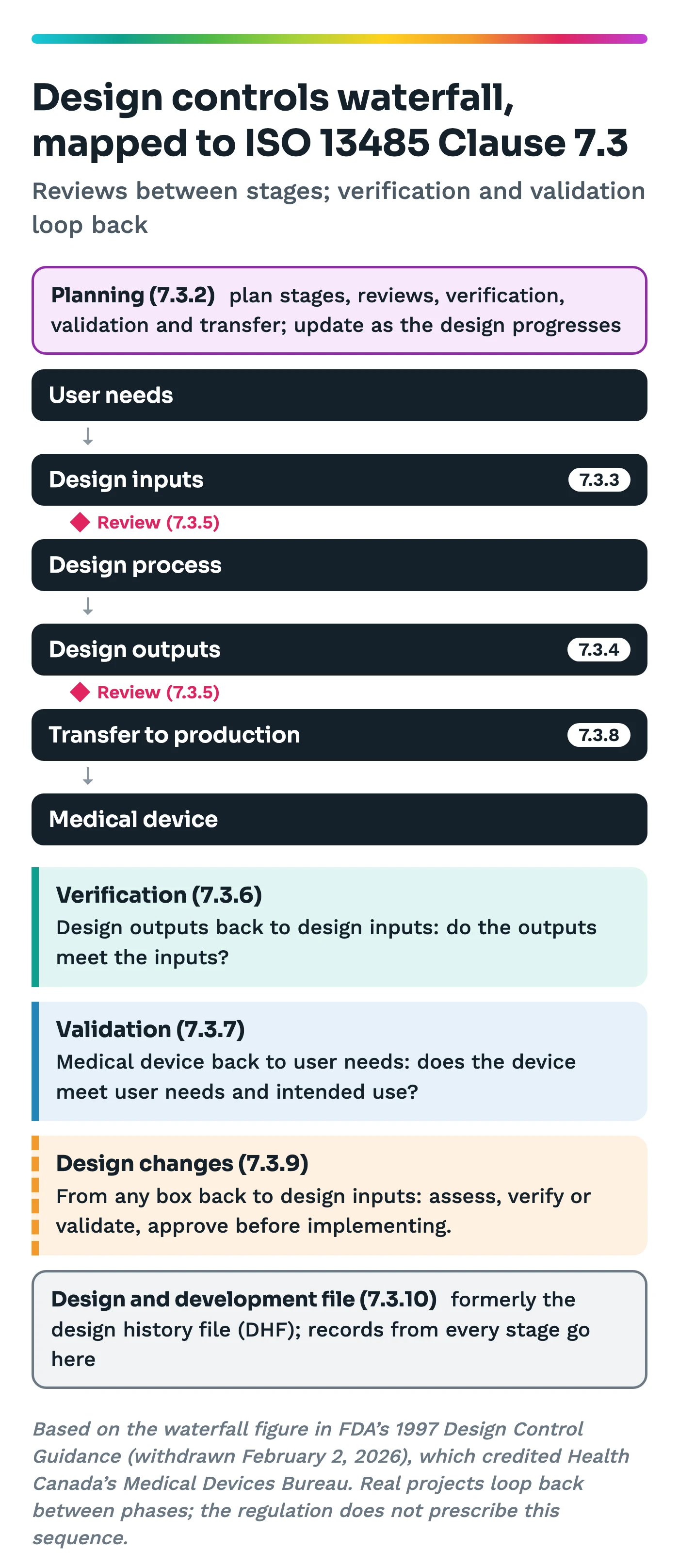
The well-known waterfall diagram comes from FDA’s 1997 guidance, which reproduced it “with permission of Medical Devices Bureau, Health Canada.” It shows user needs flowing to design input, the design process, design output and the finished device, with review at each step, verification comparing output to input, and validation comparing the device to user needs. The guidance itself said the waterfall model has limited usefulness in practice, applies to some simpler devices, and that a concurrent engineering model better represents complex device development. It also noted that, in practice, feedback paths are needed between each phase and the phases before it. The figure in this section redraws the same logic against the QMSR clause numbers.
Design verification vs validation
Verification asks whether you built the design right: do the outputs meet the inputs? Validation asks whether you built the right device: does it meet user needs and its intended use? The former Part 820 definitions put it the same way, and the QMSR now relies on the ISO 9000 definitions instead.
| Question | Design verification (Clause 7.3.6) | Design validation (Clause 7.3.7) |
|---|---|---|
| What it confirms | Design outputs meet design input requirements | The device meets user needs and intended use |
| Former 21 CFR 820.3 definition | “Confirmation by examination and provision of objective evidence that specified requirements have been fulfilled” (820.3(aa)) | “Establishing by objective evidence that device specifications conform with user needs and intended use(s)” (820.3(z)(2)) |
| Product tested | Prototypes, subassemblies, software builds or calculations, at any stage | Initial production units, lots or batches, or their equivalents (former 820.30(g)); representative product under Clause 7.3.7 |
| Typical methods | Tests, inspections and analyses (the 1997 guidance’s three approaches) | Actual or simulated use testing, clinical or performance evaluation, usability testing, software validation |
| Who is involved | Engineering and test staff | Representative users and clinical or human factors specialists, as the intended use requires |
Example (hypothetical): a home-use infusion pump has the user need “a caregiver in another room can hear the occlusion alarm.” The design input sets a minimum alarm sound level at a stated distance. Verification measures the sound level on bench units against that input. Validation puts production-equivalent pumps in a simulated home with representative caregivers and checks whether they notice and respond to the alarm. A pump can pass verification and fail validation if the input was set too low.
For clinical evaluations, FDA pointed in the preamble (Comment 47) to the clinical study rules in 21 CFR Parts 812, 50, 56 and 54. Software validation for device software sits under Clause 7.3.7; validation of software used to run the quality system or production is a separate requirement, covered in the guide to computer system validation.
Design history file: what goes in it now
DHF vs the design and development file
The design history file is now the design and development file required by Clause 7.3.10, one for each device type or device family. FDA described it in the preamble as containing or referencing all the records needed to show compliance with the design and development requirements, including the design and development plan and procedures. Renaming an existing DHF is optional; what matters is that its contents meet Clause 7.3.10. Use this list to check one file:
- Design and development plan, every approved revision
- User needs and approved design input requirements
- Risk management file, or a reference to it
- Design outputs with acceptance criteria, including labeling and packaging specifications
- Traceability matrix from user needs to verification and validation
- Design review records: design version, date, participants, decisions, actions closed
- Verification protocols and reports, with sample-size rationale where statistics are used
- Validation protocols and reports, including clinical or performance evaluation, usability and software validation
- Design transfer records and the released production specifications
- Design change records after inputs were approved, with impact and risk assessment
The medical device file (ISO 13485 4.2.3)
The medical device file replaced the device master record. FDA’s preamble says the final design output kept in the design and development file forms the starting point for the medical device file, which holds the product specifications, the procedures for manufacturing, measuring, monitoring and servicing, and installation requirements that used to sit in the DMR. Under 21 CFR 820.45(c), labeling inspection also checks devices against the labeling specified in the medical device file. Design transfer is where outputs move from one file into the other, so a gap there shows up in both.
What to do now: update your design controls for the QMSR
- Confirm scope. List your devices by class and check each against 820.10(c), including software-automated class I devices and anything under an IDE. Record any justified exclusion in the quality manual.
- Map procedures to Clause 7.3. Work through the clause table above and replace 820.30 references with the ISO 13485 subclause numbers in procedures and templates.
- Decide on design review independence. The explicit rule is gone; write down who attends each review and why, so the choice is deliberate.
- Check open projects first. Records made before February 2, 2026 need no rewrite, but active projects and new design changes must meet the QMSR now. Close gaps in their plans, trace matrices and change records.
- Index each design and development file. Run the checklist above on one file per device family and fix missing records before an investigator picks that family.
- Train the design team. Cover the new terms, the clause map and the change-control boundary, and record how you checked the training worked. Recorded design control, risk management and software sessions are listed under medical device compliance webinars.
Design problems also surface after launch through complaints and nonconformances. When a CAPA traces back to a design input, the fix runs through 7.3.9, and CAPA root cause analysis methods help show whether the design or the process failed.
Frequently asked questions
What are design controls in medical devices?
Design controls are the documented activities a manufacturer uses to make sure a device design meets user needs and its intended use: planning, design inputs, design outputs, design reviews, verification, validation, transfer to production, change control and a design file. In the US they are required for class II, class III and certain class I devices by 21 CFR 820.10(c), which applies ISO 13485:2016 Clause 7.3. They set the process and records, not the engineering choices.
Is 21 CFR 820.30 still in effect?
No. Since the QMSR took effect on February 2, 2026, sections 820.20 to 820.30 are reserved, and design controls are required through 21 CFR 820.10(c) and ISO 13485 Clause 7.3. FDA kept the same device scope as the old § 820.30(a). FDA staff have said records made before February 2, 2026 do not need to be rewritten, although investigators may still review them.
Do class I devices need design controls?
Only some. Class I devices automated with computer software and five listed devices (tracheobronchial suction catheters, non-powdered surgeon’s gloves, protective restraints, manual radionuclide applicator systems and radionuclide teletherapy sources) must meet Clause 7.3 under 21 CFR 820.10(c). Other class I devices may exclude design and development, with the exclusion justified in the quality manual. Devices under an investigational device exemption still need design controls where 820.10(c) applies to them (21 CFR 812.1(a)).
What is the difference between design verification and validation?
Verification confirms that design outputs meet design input requirements (ISO 13485 Clause 7.3.6), usually through tests, inspections and analyses. Validation confirms that the finished device meets user needs and its intended use (Clause 7.3.7), using representative product, for example production-equivalent units tested under actual or simulated use, with clinical or performance evaluation where required. A design can pass verification and still fail validation if the inputs were wrong.
Is a design history file still required under the QMSR?
The term design history file (DHF) is no longer used, but its content is still required. ISO 13485 Clause 7.3.10 requires a design and development file for each device type or family that contains or references the records showing the design met the design and development requirements. You may keep the name DHF internally if the file meets Clause 7.3.10.
Does the QMSR still require an independent reviewer at design reviews?
Not explicitly. FDA confirmed in the QMSR preamble that the old § 820.30(e) rule requiring someone without direct responsibility for the stage under review was not carried over. Clause 7.3.5 requires representatives of the functions concerned with the stage and other specialist personnel, and FDA still calls independent review an important contribution, so decide and document who attends each review.
Is FDA’s 1997 design control guidance still valid?
No. FDA withdrew “Design Control Guidance for Medical Device Manufacturers” (March 11, 1997) on February 2, 2026, and lists it as no longer representing FDA’s current thinking. It remains available for historical reference, including its waterfall diagram, but procedures should cite 21 CFR 820.10(c) and ISO 13485 Clause 7.3.
Turn user needs into testable design inputs
Alan M Golden’s recorded 60-minute webinar covers the flow of the design control process, FDA and CE mark requirements, and design inputs from user needs to product requirements. It teaches design control principles rather than the QMSR clause mapping; watch the recording any time.
See the design control webinarSources (14)
- eCFR: 21 CFR 820.10 Requirements for a quality management system (paragraph (c), design and development), current text
- eCFR: 21 CFR Part 820, Quality Management System Regulation (820.1, 820.3, 820.7, 820.35, 820.45), current text
- eCFR point-in-time (Dec. 1, 2025): former 21 CFR 820.30 Design controls
- Federal Register: Medical Devices; Quality System Regulation Amendments, final rule, 89 FR 7496 (Feb. 2, 2024)
- GovInfo: full text of the QMSR final rule (FR Doc. 2024-01709), preamble Comments 9, 30, 31, 45, 46 and 47
- eCFR: 21 CFR 812.1 Scope (IDE exemption except 820.10(c))
- eCFR: 21 CFR 4.4 Current good manufacturing practice requirements for combination products (paragraph (b)(1)(ii))
- FDA Compliance Program 7382.850, Inspection of Medical Device Manufacturers (implementation date Feb. 2, 2026), Part III section I and Attachment A
- FDA: Withdrawn or Expired Guidance (medical devices), incl. Design Control Guidance for Medical Device Manufacturers withdrawn Feb. 2, 2026 (content current as of Mar. 6, 2026)
- FDA (archived): Design Control Guidance for Medical Device Manufacturers, March 11, 1997 (withdrawn), Figure 1 and Sections F and G
- FDA CDRH town hall transcript: FDA’s QMSR: Medical Device Risk-Based Inspections (April 1, 2026)
- FDA: Quality Management System Regulation (QMSR) page (content current as of Feb. 2, 2026)
- FDA: Quality Management System Regulation – Frequently Asked Questions (content current as of Nov. 5, 2026)
- FDA: Marketing Submission Recommendations for a Predetermined Change Control Plan for Artificial Intelligence-Enabled Device Software Functions (Aug. 18, 2025), footnote 67 (PCCP implemented under Part 820 design controls)
This article is general information, not legal or tax advice. Check the official sources above or consult a qualified advisor for your situation.
How we research, check and correct articles: editorial policy. Spotted an error? Tell us.
 LIVE WEBINAR · 7 DEC · 10:00 AM PT · 1:00 PM ET
FDA Current Trends in Compliance and Enforcement for FDA-Regulated Computer Systems and Data
Carolyn Troiano · 90 min · from $179
Enroll