

Key points
- The statute sets four minimum pillars (internal controls, independent testing, a designated BSA officer and training); for banks, FinCEN’s 31 CFR 1020.210 adds ongoing customer due diligence as a fifth.
- Banks with a federal regulator must keep a written program approved by the board and recorded in the minutes; banks without one need board or equivalent governing body approval under 1020.210(b).
- No regulation fixes how often to test or train; the FFIEC manual ties testing frequency to the bank’s risk profile, gives every 12 to 18 months, or after significant changes, only as an example, and sets no training interval.
- The FFIEC manual treats a written risk assessment as sound practice, but it is not a stand-alone legal requirement for banks today; the 2026 proposal would make risk assessment processes part of the internal controls pillar.
- As of November 27, 2026, FinCEN’s April 2026 AML/CFT program proposal and the OCC, FDIC, NCUA and Federal Reserve proposals are not final; as proposed, they would take effect 12 months after a final rule is issued.
A BSA AML program is the written compliance program the Bank Secrecy Act (BSA) requires of banks, credit unions and other covered financial institutions to guard against money laundering and terrorist financing. It rests on four pillars set by statute (internal controls, independent testing, a designated BSA officer and training) plus customer due diligence, which FinCEN’s 2026 rulemakings describe as the “fifth pillar.” As of November 2026 those rules have not changed: FinCEN’s April 2026 proposal to rewrite them, and the matching banking agency proposals, are still awaiting final rules.
What are the 5 pillars of a BSA AML program?
The four statutory pillars come from 31 U.S.C. 5318(h)(1): each financial institution must establish an anti-money laundering and countering the financing of terrorism (AML/CFT) program that includes, at a minimum, internal policies, procedures and controls; a designated compliance officer; an ongoing employee training program; and an independent audit function to test the program. FinCEN’s 2016 Customer Due Diligence (CDD) Rule added risk-based ongoing customer due diligence to the program rules for banks and certain other institutions.
For banks, FinCEN’s program rule, 31 CFR 1020.210, lists all five. Each federal banking agency has a parallel rule with the first four pillars. The table shows where each pillar sits today, what examiners check under the Federal Financial Institutions Examination Council (FFIEC) BSA/AML Examination Manual, and what the April 2026 proposal would change if it is finalized as written.
| Pillar | Current rule for banks | What examiners look for (FFIEC manual) | What the April 2026 proposal would change |
|---|---|---|---|
| 1. Internal controls | 31 CFR 1020.210(a)(2)(i); 12 CFR 21.21(d)(1), 208.63(c)(1), 326.8(c)(1), 748.2(c)(1) | Controls that reflect the bank’s risk assessment, segregation of duties, timely updates for new rules, and reports to the board on deficiencies and SAR filings | A “risk-based set of internal policies, procedures, and controls” that must include documented risk assessment processes and direct more resources to higher-risk customers and activities |
| 2. Independent testing | 1020.210(a)(2)(ii): by bank personnel or an outside party | Tester independence, risk-based scope, results reported to the board or a board committee, frequency suited to the risk profile | Kept; testing should use objective criteria, and testers should not substitute their own judgment for the institution’s |
| 3. BSA officer | 1020.210(a)(2)(iii): an individual or individuals coordinating and monitoring day-to-day compliance | Qualifications, authority, independence, resources and regular reporting to the board | Officer must be located in the United States and is responsible for establishing and implementing the program |
| 4. Training | 1020.210(a)(2)(iv): training for appropriate personnel | Role-based content, board training and records of who was trained and when | Wording becomes the statute’s “ongoing employee training program”; FinCEN calls this clarifying, not substantive |
| 5. Customer due diligence | 1020.210(a)(2)(v) and 31 CFR 1010.230 (beneficial owners) | Customer risk profiles, ongoing monitoring and beneficial ownership procedures | Moves under the internal controls pillar with no intended change in substance |
What internal controls have to cover
Internal controls are the bank’s policies, procedures and processes for meeting every BSA requirement that applies to it. The core reporting and recordkeeping duties for banks include:
- Suspicious Activity Reports (SARs): under 31 CFR 1020.320, a SAR is due no later than 30 calendar days after initial detection of facts that may require one; if no suspect is identified, filing may be delayed up to 30 more days, never past 60 days. FinCEN’s rule applies at $5,000, and the banking agencies’ SAR rules (for example 12 CFR 21.11) add other triggers, such as insider abuse in any amount.
- Currency Transaction Reports (CTRs): for each transaction in currency of more than $10,000 (31 CFR 1010.311), counting multiple transactions by or for the same person that the bank knows total more than $10,000 in one business day (1010.313), filed within 15 days (1010.306), subject to the exemptions in 31 CFR 1020.315.
- Customer Identification Program (CIP): required by 31 CFR 1020.220, which makes the CIP part of the bank’s AML program; each banking agency’s program rule cross-references it.
- Recordkeeping: five years for SARs and supporting documents, CTRs and other BSA records (1020.320(d), 1010.306(a)(2), 1010.430(d)).
- OFAC sanctions: a separate Treasury regime (31 CFR chapter V), which the FFIEC manual covers in its own section.
Customer due diligence, the fifth pillar
Banks must understand the nature and purpose of each customer relationship to build a customer risk profile, and monitor on an ongoing basis to report suspicious activity and, on a risk basis, keep customer information current. For legal entity customers, 31 CFR 1010.230 requires identifying and verifying each individual who owns 25 percent or more of the equity interests and one individual with significant responsibility to control the entity, unless the customer or account falls under one of the rule’s exclusions or exemptions.
Two 2026 changes affect this pillar. FinCEN’s exceptive relief order FIN-2026-R001 (February 13, 2026) lets covered institutions identify and verify beneficial owners when a legal entity customer first opens an account, again when facts call the information into question, and as their risk-based CDD procedures require, rather than at every new account. A separate CDD proposal published November 19, 2026 would write that relief into the rule, list the beneficial owner information to collect in the rule text, limit use of an Individual Taxpayer Identification Number (ITIN) for that collection, and make explicit that institutions may ask for more information where risk warrants it, including immigration status and work authorization when relevant. Comments are due January 19, 2027.
BSA AML program requirements: who needs one and who approves it?
Eleven types of financial institutions are covered by FinCEN AML program rules today: banks, casinos and card clubs, money services businesses, broker-dealers, mutual funds, insurance companies, futures commission merchants and introducing brokers, dealers in precious metals, stones or jewels, operators of credit card systems, loan or finance companies, and housing government-sponsored enterprises (31 CFR 1020.210 through 1030.210). Registered investment advisers were added by a 2024 rule whose effective date has been delayed to January 1, 2028. Each type has its own rule; this guide covers banks and credit unions.
Board approval and oversight
A bank with a federal functional regulator meets FinCEN’s rule partly by complying with its regulator’s program rule, and each of those rules requires a written program approved by the board of directors.
| Institution | Program rule | Approval requirement today |
|---|---|---|
| National banks and federal savings associations (OCC) | 12 CFR 21.21 | Written, approved by the board, reflected in the minutes |
| State member banks (Federal Reserve) | 12 CFR 208.63 | In writing, approved by the board, noted in the minutes |
| FDIC-supervised institutions (as defined in 12 CFR 326.1) | 12 CFR 326.8 | Written, approved by the board, noted in the minutes |
| Federally insured credit unions (NCUA) | 12 CFR 748.2 | Written, approved by the board, reflected in the minutes |
| Banks without a federal functional regulator (for example private banks, non-federally insured credit unions, certain trust companies) | 31 CFR 1020.210(b) | Written, approved by the board or, if there is no board, an equivalent governing body; a copy to FinCEN on request |
Approval is the start of board oversight, not the whole of it. The FFIEC manual says the board is ultimately responsible for BSA compliance, must make sure the BSA officer has enough authority, independence and resources, and that appointing a BSA officer is not by itself enough to meet the program requirement.
What does a BSA officer do?
The rules require “designation of an individual or individuals responsible for coordinating and monitoring day-to-day compliance” (the NCUA rule says “an individual”). The FFIEC manual adds that the board must designate a qualified person, that the title does not matter, and that the officer’s authority, independence and access to resources are what examiners weigh.
- Runs the program day to day and may delegate duties to staff while staying responsible for them.
- Reports regularly to the board and senior management on the status of compliance, including notice of SAR filings.
- Has a say in changes: the FFIEC treats senior management seeking the officer’s input on new products, services, customer types, locations and system changes as a sign of appropriate authority.
- Knows the bank’s risk profile and the BSA rules well enough to show competence to examiners.
Under the 2026 proposal the officer, renamed the AML/CFT officer, would have to be located in the United States and be accessible to FinCEN and the bank’s regulator, as the AML Act already requires of the persons responsible for the program. Staff outside the United States could still perform some AML/CFT functions. FinCEN’s preamble also says the officer should be qualified and not overburdened with other responsibilities.
BSA audit: how often is independent testing required?
No regulation sets a frequency. The rules require only “independent testing for compliance to be conducted by bank personnel or by an outside party.” The FFIEC manual states that there is no regulatory requirement for independent testing frequency and that testing should be commensurate with the bank’s risk profile. A bank may test at periodic intervals, for example every 12 to 18 months, and when its risk profile, systems, compliance staff or processes change significantly, and more often when errors or deficiencies have been found.
Internal audit vs outside party
Testing can be done by internal audit, outside auditors or consultants, or, at banks without those, qualified bank staff who are not involved in the function being tested. An outside firm should not also do other BSA work at the bank that could compromise its independence, such as training or writing policies. Whoever tests should report directly to the board or to a board committee made up primarily or completely of outside directors (FFIEC manual, independent testing). Smaller, lower-risk banks may share a testing resource with other banks.
The FFIEC manual lists what a risk-based test may review: whether the risk assessment matches the bank’s products, services, customers and locations; whether policies follow that risk profile and staff follow the policies; CIP, CDD, beneficial ownership, SAR, CTR and exemption compliance; the SAR decision process; the accuracy of the systems behind monitoring and reports; training records; and whether earlier findings were fixed. The report should give a conclusion on overall BSA compliance or enough information to reach one.
The 2026 proposal keeps the pillar. FinCEN’s preamble says the AML/CFT officer, or anyone reporting to that officer, would generally not be independent enough to do the testing, and that outside testers should not be involved in functions such as AML/CFT training or writing the policies they test.
BSA AML training requirements: who, what and how often
The rules require “training for appropriate personnel” and set no frequency. The FFIEC manual expects training to cover the BSA requirements relevant to the bank, supervisory guidance and the bank’s own procedures, tailored to each person’s duties, and documented so auditors and examiners can review it. BSA/AML is one item on the wider list of required training for bank employees, which also covers topics outside the BSA.
| Audience | What the FFIEC manual expects | Evidence to keep |
|---|---|---|
| New employees | An overview of the BSA’s purposes and requirements at orientation or reasonably soon after | Completion date for each new hire |
| Front-line staff, such as tellers | Examples tailored to their area, such as large currency transactions and suspicious activity | Materials, dates, attendance |
| Lending, trust, private banking and correspondent banking staff | Targeted training on the risks of their business line | Materials, dates, attendance |
| BSA officer and BSA staff | Periodic training on regulatory changes and changes in the bank’s risk profile | Courses taken, dates |
| Board and senior management | Foundational training and updates on new BSA developments, enough to oversee the program | Board minutes or attendance records |
| Agents performing BSA functions | Training for agents responsible for BSA-related functions on the bank’s behalf | Records from the agent or third-party trainer |
Keep the training and testing materials, session dates, attendance, and any failures to complete training on time with the corrective action taken. An annual schedule is a choice the bank can make, not a legal rule. FinCEN’s preamble to the 2026 proposal says the frequency and content of training depend on the institution’s risk profile and each person’s role, and that institutions may decide which employees and non-employees need ongoing training.
BSA AML risk assessment: is it now a pillar?
Not under today’s bank rules. The FFIEC manual calls a well-developed BSA/AML risk assessment “not a specific legal requirement,” but it is where examiners start: they review it during exam scoping to understand the bank’s money laundering and terrorist financing risks. The FFIEC describes two steps: identify the risk categories (products, services, customers and geographic locations), then analyze the data in each, such as the number and dollar amount of funds transfers. Putting it in writing is described as sound practice.
The 2026 proposal would not add a separate pillar. It would make risk assessment processes an explicit part of the internal controls pillar. Under proposed 1020.210(b)(1)(i), the processes would have to:
- Evaluate the risks of the bank’s business activities, including its products, services, distribution channels, customers and geographic locations.
- Review and, as appropriate, incorporate the AML/CFT Priorities.
- Be updated promptly upon any change that the bank knows or has reason to know significantly changes its risks.
AML/CFT National Priorities
FinCEN published the first government-wide AML/CFT Priorities on June 30, 2021. In no particular order: corruption; cybercrime, including cybersecurity and virtual currency considerations; foreign and domestic terrorist financing; fraud; transnational criminal organization activity; drug trafficking organization activity; human trafficking and human smuggling; and proliferation financing. The statute requires an update at least every four years, but the April 2026 proposal still cites the 2021 list. FinCEN’s fact sheet says institutions will not have to incorporate the priorities into their programs until a final rule takes effect.
Fraud is one of the eight. For ACH payments it also carries separate private-rule duties: the Nacha fraud monitoring rules took effect in two phases in 2026.
FinCEN’s 2026 AML/CFT program proposal: what would change?
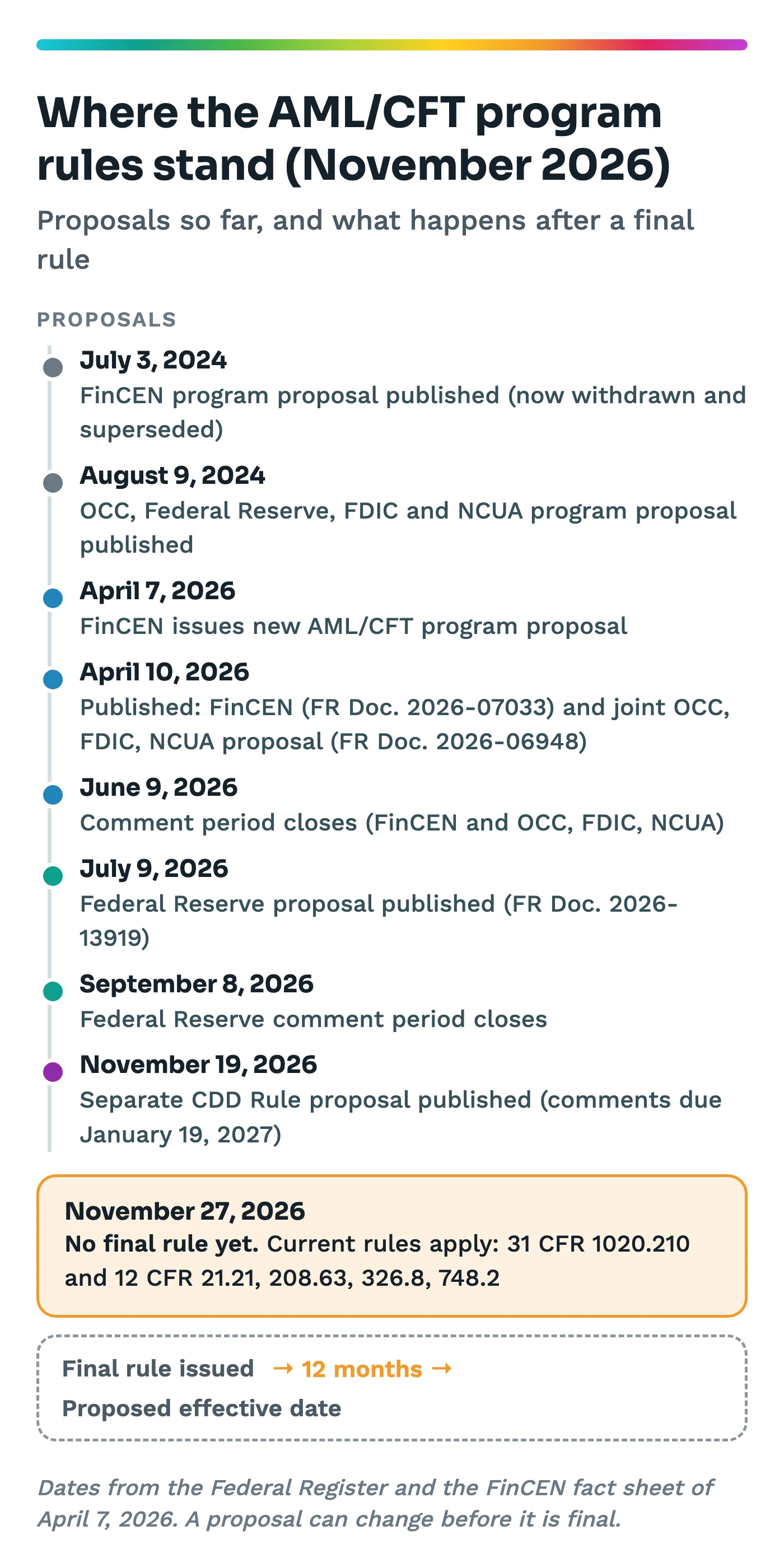
FinCEN issued the proposal on April 7, 2026, and the Federal Register published it on April 10 (FR Doc. 2026-07033, docket FINCEN-2026-0034). It covers all eleven types of financial institutions with FinCEN program rules. The OCC, FDIC and NCUA proposed matching changes to their own rules the same day (FR Doc. 2026-06948), and the Federal Reserve followed on July 9, 2026 (FR Doc. 2026-13919).
Status as of November 2026
| Date | Step |
|---|---|
| July 3, 2024 | FinCEN’s earlier program proposal published (the banking agencies followed on August 9, 2024); the 2026 FinCEN proposal says the 2024 FinCEN proposal is withdrawn and superseded |
| April 10, 2026 | FinCEN proposal and the joint OCC, FDIC and NCUA proposal published |
| June 9, 2026 | Comment period closed for both |
| July 9, 2026 | Federal Reserve proposal published; comments closed September 8, 2026 |
| November 19, 2026 | Separate CDD Rule proposal published; comments due January 19, 2027 |
| As of November 27, 2026 | No final rule published by FinCEN or any banking agency |
| Final rule (no date set) | Proposed effective date: 12 months after the final rule is issued |
“Establish” and “maintain” an effective program
An AML/CFT program would be “effective” if the institution establishes it as the rule requires and maintains it by implementing it “in all material respects.” Keeping the program current as the risk profile changes would count as part of establishing it. For banks, once a program is properly established, FinCEN says implementation problems would warrant an enforcement action or a significant supervisory action only if they are significant or systemic failures, not isolated, technical or immaterial issues.
Risk-based resources, approval and supervision
- Resources: controls must direct more attention and resources toward higher-risk customers and activities, rather than lower-risk ones, consistent with the documented risk assessment.
- U.S.-based officer: the AML/CFT officer must be in the United States, as described above.
- Approval: the written program could be approved by the board, an equivalent governing body or appropriate senior management. The OCC, FDIC and NCUA proposal says boards would still be expected to oversee the program.
- FinCEN’s role: before a significant AML/CFT supervisory action taken under FinCEN’s delegated authority, a banking agency would give FinCEN at least 30 days’ written notice, absent urgent circumstances, and consider its input.
- Effective date: 12 months after the final rule is issued; FinCEN’s 2024 proposal had proposed six months.
Until final rules take effect, banks are examined against the current 31 CFR 1020.210 and their regulator’s rule. A proposal can change before it is finalized, so treat the details above as proposed text, not requirements.
BSA AML compliance checklist for 2027 planning
Use this list to check each pillar against today’s rules and to prepare for a final rule without acting on proposed text too early.
- The written BSA/AML program is current, approved by the board (or the body your rule names) and, where your rule requires it, reflected in the minutes.
- The board has designated a qualified BSA officer and minutes show regular compliance reports, including notice of SAR filings.
- The BSA officer has enough staff, systems and authority for the bank’s risk profile, and conflicting duties are documented and managed.
- The risk assessment covers products, services, customers, geographic locations and distribution channels, and is in writing.
- The risk assessment was updated after each new product, new market, merger or system change.
- The AML/CFT Priorities have been reviewed against the bank’s actual exposure, with the result recorded.
- Independent testing frequency is set by risk, and the tester is independent of the BSA function and reports to the board or an outside-director committee.
- Every finding from the last independent test and examination has an owner, a due date and evidence of closure.
- Training is assigned by role, including the board and agents, and attendance and missed training are tracked.
- CIP, CDD and beneficial ownership procedures reflect FIN-2026-R001 if the bank chose to use that relief.
- SAR, CTR and recordkeeping procedures were tested against 30-day, 15-day and five-year timelines.
- Someone is assigned to track the final FinCEN, OCC, FDIC, NCUA and Federal Reserve rules and the CDD proposal.
What to do now
- Brief the board. Explain that the 2026 proposals are not final, what would change, and that the current rules still apply.
- Refresh the risk assessment. Document product, customer, geographic and channel risk, and map it to the eight AML/CFT Priorities so the work is ready if the proposal is finalized.
- Check where resources go. Compare staffing and monitoring effort with the risk assessment, and record why lower-risk areas get less.
- Confirm independent testing. Set the next test date by risk, confirm tester independence, and close open findings.
- Update role-based training. The recorded FFIEC BSA/AML Examination Manual webinar with Justin Muscolino covers the AML risk assessment, the BSA/AML compliance program, CIP, CDD and EDD, suspicious activity and currency transaction reporting, and exam best practices. More sessions are listed under banking and finance webinars.
Frequently asked questions
What are the 5 pillars of BSA/AML?
Internal policies, procedures and controls; independent testing; a designated BSA compliance officer; training for appropriate personnel; and risk-based ongoing customer due diligence. The first four are minimum elements in 31 U.S.C. 5318(h)(1) and the banking agencies’ rules; the fifth was added to FinCEN’s program rules for banks and certain other institutions by the 2016 CDD Rule and appears in 31 CFR 1020.210(a)(2)(v).
Is the risk assessment a pillar of BSA/AML?
Not under current bank rules. The FFIEC BSA/AML Examination Manual calls a well-developed risk assessment “not a specific legal requirement,” although examiners review it during exam scoping and planning. FinCEN’s April 2026 proposal would require risk assessment processes as part of the internal controls pillar rather than as a separate pillar, but as of November 2026 that proposal is not final.
Who must approve the BSA/AML program?
For national banks, federal savings associations, state member banks, FDIC-supervised institutions and federally insured credit unions, the board of directors must approve the written program and the approval must be noted or reflected in the minutes (12 CFR 21.21, 208.63, 326.8 and 748.2). A bank without a federal functional regulator needs approval by its board or, if it has no board, an equivalent governing body (31 CFR 1020.210(b)). The 2026 proposals would also allow approval by appropriate senior management, but they are not final.
How often is BSA/AML training required?
No regulation sets a frequency: the rules require “training for appropriate personnel.” The FFIEC manual expects an overview for new staff at orientation or reasonably soon after, periodic training for the BSA officer and BSA staff, foundational training and updates for the board, and documentation of who was trained and when. An annual cycle is an internal choice, not a legal requirement.
How often must BSA independent testing be done?
No regulation sets a frequency. The FFIEC manual says testing should be commensurate with the bank’s risk profile, gives periodic intervals such as every 12 to 18 months and testing after significant changes as examples, and suggests more frequent testing when deficiencies have been found. The tester must be independent of the BSA function and should report to the board or a board committee made up primarily or completely of outside directors.
Is FinCEN’s 2026 AML/CFT program rule final?
No. As of November 27, 2026, FinCEN’s proposal (published April 10, 2026, FR Doc. 2026-07033) and the matching OCC, FDIC and NCUA proposal (April 10) and Federal Reserve proposal (July 9) have not been finalized. Their comment periods closed June 9 and September 8, 2026, and each proposes an effective date 12 months after a final rule is issued, so banks are examined under the current rules until then.
Get regulation updates and new banking webinars
The weekly 247Compliance email lists new live sessions and regulation updates. Unsubscribe any time.
SubscribeSources (28)
- Federal Register: FinCEN, Anti-Money Laundering and Countering the Financing of Terrorism Programs, proposed rule, 91 FR 18704 (Apr. 10, 2026), FR Doc. 2026-07033, RIN 1506-AB72, docket FINCEN-2026-0034
- GovInfo PDF of FR Doc. 2026-07033
- FinCEN: Fact Sheet, Proposed Rule to Fundamentally Reform Financial Institution AML/CFT Programs (April 7, 2026)
- Federal Register: OCC, FDIC and NCUA, Anti-Money Laundering and Countering the Financing of Terrorism Programs, proposed rule, 91 FR 18304 (Apr. 10, 2026), FR Doc. 2026-06948
- Federal Register: Federal Reserve Board, Anti-Money Laundering and Countering the Financing of Terrorism Programs, proposed rule, 91 FR 42363 (July 9, 2026), FR Doc. 2026-13919
- Federal Register: FinCEN, Customer Due Diligence Requirements for Covered Financial Institutions, proposed rule, 91 FR 74514 (Nov. 19, 2026), FR Doc. 2026-23614 (also describes FIN-2026-R001)
- FinCEN: FIN-2026-R001, Exceptive Relief from Requirement to Identify and Verify Beneficial Owners at Each Account Opening (Feb. 13, 2026)
- 31 U.S.C. 5318(h) Anti-money laundering programs; (h)(4) AML/CFT priorities; (h)(5) duty of U.S. persons (GovInfo, 2023 edition)
- eCFR: 31 CFR 1020.210 Anti-money laundering program requirements for banks
- eCFR: 31 CFR 1010.230 Beneficial ownership requirements for legal entity customers
- eCFR: 31 CFR 1020.220 Customer identification program requirements for banks
- eCFR: 31 CFR 1020.320 Reports by banks of suspicious transactions (30/60-day filing, $5,000, five-year retention)
- eCFR: 31 CFR 1010.311 Filing obligations for reports of transactions in currency (more than $10,000)
- eCFR: 31 CFR 1010.306 Filing of reports (CTR within 15 days; five-year retention)
- eCFR: 31 CFR 1010.430 Nature of records and retention period (five years)
- eCFR: 31 CFR 1020.315 Transactions of exempt persons
- eCFR: 12 CFR 21.21 Procedures for monitoring Bank Secrecy Act (BSA) compliance (OCC)
- eCFR: 12 CFR 21.11 Suspicious Activity Report (OCC; thresholds and board notification)
- eCFR: 12 CFR 208.63 Procedures for monitoring Bank Secrecy Act compliance (Federal Reserve)
- eCFR: 12 CFR 326.8 Bank Secrecy Act compliance (FDIC)
- eCFR: 12 CFR 748.2 Procedures for monitoring Bank Secrecy Act (BSA) compliance (NCUA)
- FFIEC BSA/AML Examination Manual: Assessing the BSA/AML Compliance Program (overview)
- FFIEC BSA/AML Examination Manual: BSA/AML Internal Controls
- FFIEC BSA/AML Examination Manual: BSA/AML Independent Testing
- FFIEC BSA/AML Examination Manual: BSA Compliance Officer
- FFIEC BSA/AML Examination Manual: BSA/AML Training
- FFIEC BSA/AML Examination Manual: BSA/AML Risk Assessment
- FinCEN: Anti-Money Laundering and Countering the Financing of Terrorism National Priorities (June 30, 2021)
This article is general information, not legal or tax advice. Check the official sources above or consult a qualified advisor for your situation.
How we research, check and correct articles: editorial policy. Spotted an error? Tell us.
 LIVE WEBINAR · 3 DEC · 12:00 PM PT · 3:00 PM ET
NEW Nacha Operating Rules for 2026
Donna K Olheiser · 90 min · from $179
Enroll