

Key points
- 21 CFR Part 11 applies when records or signatures required by another FDA rule (a predicate rule) are kept or submitted electronically; paper records sent by fax and certain food safety records are outside it.
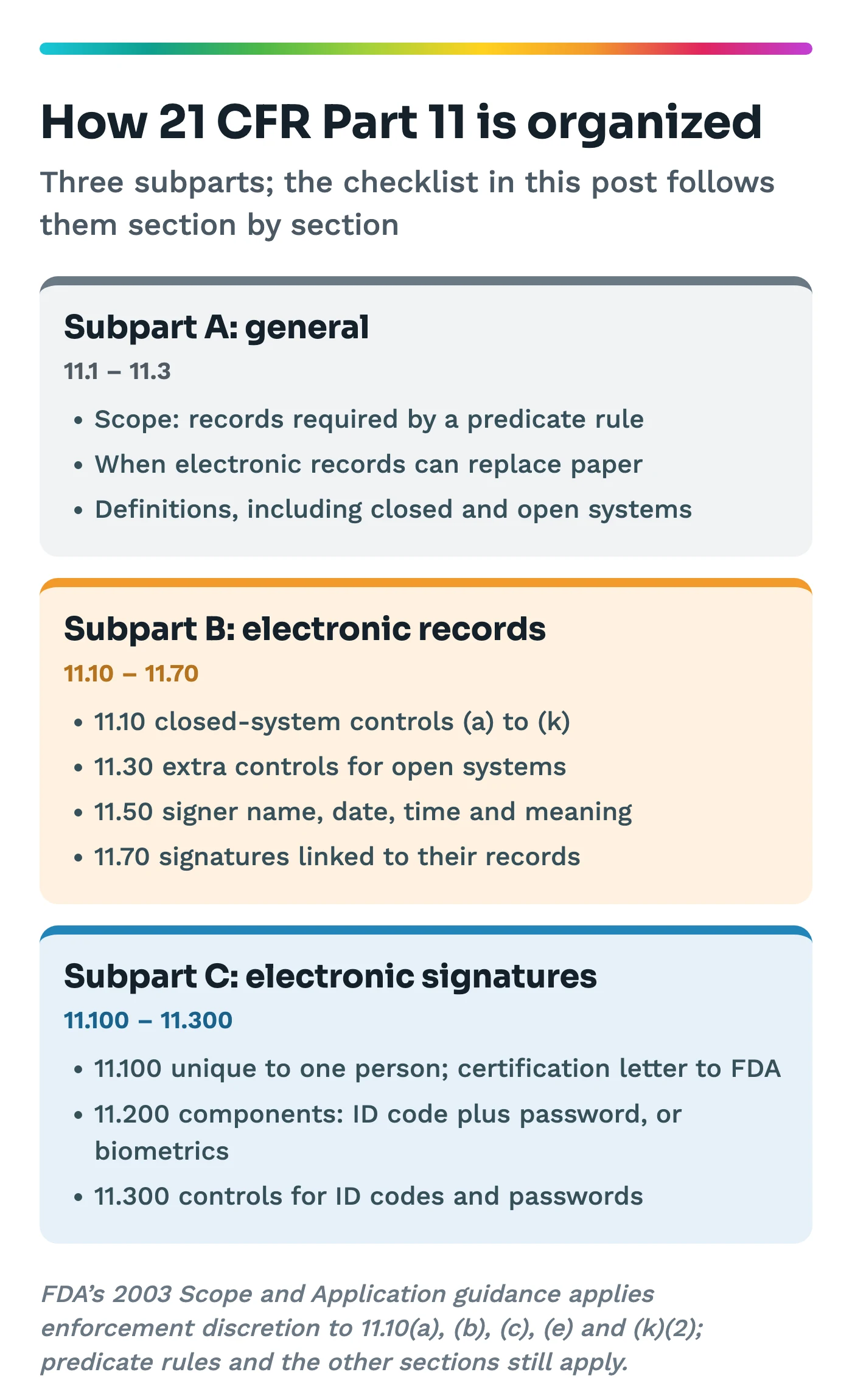
- FDA’s August 2003 guidance applies enforcement discretion to validation (11.10(a)), copies (11.10(b)), retention (11.10(c)), audit trails (11.10(e), (k)(2)) and qualifying legacy systems; predicate-rule requirements, including any validation they require, and all other Part 11 provisions still apply.
- Signed records must show the signer’s name, date and time and meaning (11.50), and signatures must be linked to their records (11.70).
- Section 11.100(c) requires a hand-signed certification letter to FDA; since March 2, 2023 it can be sent electronically or on paper, and one letter can cover the whole organization.
- The October 2024 clinical investigations guidance and the February 2026 CSA guidance add detail on audit trails, vendors and validation; the 2026 guidance says the 11.10(a) discretion does not cover validation of production and quality management system software under ISO 13485.
21 CFR Part 11 is FDA’s regulation on electronic records and electronic signatures. It applies when a record required by another FDA regulation is kept or submitted electronically, or a required signature is applied electronically. This 21 CFR Part 11 compliance checklist covers every section, from scope and the 11.10(a) to (k) closed-system controls to the signature rules in 11.50 to 11.300, with the question to ask, the evidence to keep and the provisions FDA has said since 2003 it does not intend to enforce, a policy its October 2024 guidance still applies. The text was checked on eCFR in November 2026: sections 11.10 to 11.300 are unchanged since 1997 apart from a 2023 amendment to 11.100(c).
What is 21 CFR Part 11 and when does it apply?
Part 11 took effect on August 20, 1997. Subpart A holds the general provisions (11.1 to 11.3), Subpart B the electronic record controls (11.10 to 11.70) and Subpart C the electronic signature rules (11.100 to 11.300). Part 11 does not say which records to keep; the predicate rules do. These are the FD&C Act, the PHS Act and FDA regulations other than Part 11, such as drug CGMP (Part 211), GLP (Part 58), clinical investigations (Parts 312 and 812) and the device rule explained in the post on the FDA QMSR. The validation 11.10(a) asks for is planned and documented as described in the guide to computer system validation.
Scope, implementation and definitions (11.1 to 11.3)
- 11.1(b): Part 11 covers electronic records created, modified, maintained, archived, retrieved or transmitted under any FDA records requirement, and electronic records submitted under the FD&C Act and PHS Act. It does not apply to paper records transmitted electronically, such as a fax.
- 11.1(c) to (e): compliant electronic signatures count as handwritten signatures, initials and other signings, unless a regulation effective on or after August 20, 1997 excepts them; compliant electronic records may replace paper unless paper is specifically required; systems, controls and documentation must be readily available for FDA inspection.
- 11.1(f) to (p): records required only by certain food safety rules (such as Parts 112, 117, 121 and 507) and signatures under two food labeling provisions are excluded; a record that another rule also requires stays in scope.
- 11.2: records you keep may be electronic if Part 11 is met; records you submit must also be a type listed in public docket No. 92S-0251.
- 11.3: a closed system is one where access is controlled by the people responsible for the records’ content; in an open system it is not. The section also defines electronic, digital and handwritten signatures and biometrics.
Does Part 11 apply to your system? Predicate rules decide
FDA’s Part 11 Scope and Application guidance (dated August 2003, announced September 2003) reads Part 11 narrowly. It covers predicate-rule records kept electronically instead of on paper, records kept in both forms where you rely on the electronic one, records submitted to FDA electronically, and electronic signatures meant to equal the signings predicate rules require. If you print records, the printouts meet the predicate rules and you work from the paper, Part 11 generally does not apply, but FDA can look at what staff actually rely on. Decide for each record type which version is official and document it in an SOP.
Hybrid and legacy systems
Hybrid systems mix paper and electronic components, such as handwritten signatures executed to electronic records, or paper records combined with electronic signatures. The 2003 guidance accepts them if predicate rules are met and the records keep their content and meaning. For legacy systems, operational before August 20, 1997, FDA does not intend to enforce Part 11 if all four conditions hold: the system was operational before that date, met the predicate rules then, meets them now, and has documented evidence that it is fit for its intended use. If changes stop it meeting predicate rules, Part 11 controls should be applied to it, still under the enforcement policy in the 2003 guidance.
Which Part 11 requirements does FDA enforce? The 2003 FDA guidance
The 2003 guidance states that Part 11 remains in effect. FDA said it intends to exercise enforcement discretion for four groups of requirements, and the matching 11.30 requirements, plus legacy systems, while enforcing every predicate rule. FDA’s October 2024 clinical guidance confirms the agency still applies this narrow and practical interpretation.
| Provision | FDA’s 2003 position | What still applies |
|---|---|---|
| 11.10(a) validation | Enforcement discretion | Predicate-rule validation, such as 211.68 for drugs and ISO 13485 clauses 4.1.6, 7.5.6 and 7.6 under the QMSR, scaled by a documented risk assessment |
| 11.10(b) copies of records | Enforcement discretion | Reasonable access for FDA investigators; copies in common formats such as PDF or XML that keep content and meaning |
| 11.10(c) protection through the retention period | Enforcement discretion | Predicate retention rules; archiving to paper, microfilm or a standard file format is acceptable |
| 11.10(e) and (k)(2) audit trails | Enforcement discretion | Predicate rules on dates, sequencing and changes that must not obscure earlier entries (for example 58.130(e)) |
| Legacy systems | Discretion if all four conditions are met | All predicate rules |
| 11.10(d), (f) to (j) and (k)(1); matching 11.30 controls; 11.50 to 11.300 | Enforced | The full text |
Two cautions. The validation example it cites, 820.70(i), was removed when the QMSR took effect on February 2, 2026. And discretion is not an exemption: inspectors can cite the predicate rule when an audit trail is switched off or a record cannot be reconstructed.
21 CFR Part 11 requirements by section: the checklist
Run it for each system that holds Part 11 records, highest risk first. A “no” on an enforced provision is a gap. A “no” on a discretion provision needs a documented predicate-rule basis and risk assessment. To print it, copy the table into your own form and add columns for the answer and the owner.
| Section | Requirement | Checklist question | Evidence to keep |
|---|---|---|---|
| 11.10(a) | Validation for accuracy, reliability, consistent intended performance and detecting invalid or altered records | Validated for intended use, including detection of altered records? | Validation plan, risk assessment, tests, report |
| 11.10(b) | Accurate, complete copies in human readable and electronic form | Can you export a full record with metadata and audit trail? | Tested export procedure |
| 11.10(c) | Accurate, ready retrieval through the retention period | Retrievable after upgrades, migrations and restores? | Restore tests; archive SOP |
| 11.10(d) | Access limited to authorized individuals | Named, approved accounts only? | Access approvals and reviews |
| 11.10(e) | Secure, computer-generated, time-stamped audit trails | Audit trail on, protected and kept as long as the records? | Configuration, tests, review records |
| 11.10(f) | Operational checks on the sequence of steps, as appropriate | Are out-of-order steps blocked where order matters? | Workflow tests |
| 11.10(g) | Authority checks so only authorized individuals can use the system, sign a record electronically, access input or output devices, alter a record or perform the operation | Do roles stop signing or editing outside a user’s authority? | Role matrix; negative tests |
| 11.10(h) | Device checks on the validity of the input source, as appropriate | Is the instrument or terminal confirmed where it matters? | Interface tests |
| 11.10(i) | Education, training and experience for developers, maintainers and users | Is everyone qualified for their tasks? | Training records, CVs |
| 11.10(j) | Written policies holding signers accountable | Have signers acknowledged the e-signature policy? | Signed acknowledgments |
| 11.10(k) | Control of system documentation, with change control and a dated revision history | Are manuals and admin SOPs controlled? | Document and change records |
| 11.30 | 11.10 controls as appropriate, plus measures such as encryption and digital signature standards | Are records protected from creation to receipt? | Security design, encryption settings |
| 11.50 | Printed name, date and time, and meaning in every readable form | Shown on screen and on printouts? | Test screenshots |
| 11.70 | Signatures linked to their records | Can a signature be copied to another record? | Test evidence |
| 11.100(a), (b) | Unique, never reused or reassigned; identity verified first | Unique IDs, identity checked? | ID policy; verification records |
| 11.100(c) | Certification letter to FDA | Has the letter been sent? | Signed letter; proof of submission |
| 11.200 | Two components, or biometrics usable only by the owner | Right components asked at each signing? | Configuration tests |
| 11.300 | Five ID code and password controls | Are all five in place? | Password policy; lost-token SOP; alerts |
Closed or open system? (11.30)
The 11.3 test is who controls access, not whether the system uses the internet. If the people responsible for the record content control access, 11.10 applies. If not, 11.30 adds measures such as encryption and digital signature standards to protect records from creation to receipt. Record the classification and reasoning for each system.
21 CFR Part 11 audit trail requirements
What the audit trail must capture
Section 11.10(e) requires secure, computer-generated, time-stamped audit trails that independently record the date and time of operator entries and actions that create, modify or delete electronic records. Changes must not obscure earlier information, and audit trail documentation must be kept at least as long as the records and be available for FDA review and copying. The rule does not mention reasons for changes, but some predicate rules do, such as the GLP rule in 58.130(e). For trials, FDA’s 2024 guidance adds:
- entries must include the date and time, who made the change (for example, user ID and role) and the old and new values, and should include the reason where applicable;
- audit trails should be protected from modification and from being disabled;
- deliberate actions such as save or submit, and edits to completed fields, should be captured, but not every keystroke;
- keep them searchable and sortable, or in a static format such as PDF if that is not practical.
Across time zones, the 2003 guidance says the signer’s local time is not required, but system documentation should explain the time zone reference.
Audit trail review in practice
Part 11 sets no review frequency. FDA’s data integrity Q&A guidance (December 2018) says the people who review CGMP records should review audit trails of changes with the rest of the record, at the frequency CGMP sets for the data, such as before batch release, and otherwise by risk. For trials, the 2024 guidance says periodic review may be helpful and should rest on a risk assessment. Audit trails support the ALCOA+ data integrity principles that define a trustworthy record.
Electronic signature requirements under 21 CFR Part 11
Signature manifestation and linking (11.50 and 11.70)
Under 11.50, a signed record must show the signer’s printed name, the date and time of signing and its meaning (such as review, approval, responsibility or authorship), under the same controls as the record and in any human readable form. Under 11.70, electronic signatures and handwritten signatures executed to electronic records must be linked so they cannot be excised, copied or transferred to falsify a record by ordinary means. The 2024 guidance treats a signature drawn with a finger or stylus as a handwritten signature, which must still be linked.
Uniqueness, identity and the FDA certification letter (11.100)
Each electronic signature must be unique to one person and never reused by or reassigned to anyone else, and the organization must verify the person’s identity before issuing it. The 2024 guidance lists government-issued ID, security questions, or strong login credentials with multi-factor authentication or video observation as options.
Under 11.100(c), before or at the time of use, you must certify to FDA that the electronic signatures in your system, used on or after August 20, 1997, are intended to be the legally binding equivalent of handwritten signatures. Since March 2, 2023, the hand-signed certification can be sent in electronic or paper form, as described on FDA’s Letters of Non-Repudiation Agreement page. That page (current as of July 16, 2026) offers individual and company-wide letters uploaded through the Electronic Submissions Gateway’s Unified Submission Portal and says a mailed copy is now optional. One letter can cover a whole organization, and FDA can ask for further certification or testimony under 11.100(c)(2).
Non-biometric and biometric signatures (11.200)
Signatures not based on biometrics need at least two distinct components, such as an ID code and password. In one continuous period of controlled access, the first signing uses all components and later signings use at least one component only the individual can execute; signings outside such a period use all components each time. They must be used only by their genuine owners, and misuse by anyone else must require two or more people to collaborate. Biometric signatures must be designed so only their genuine owners can use them.
Password and token controls (11.300)
- Unique ID code and password combinations.
- Periodic checks, recall or revision of issuances, for example for password aging.
- Loss management: electronically deauthorize lost, stolen or compromised tokens and cards, and reissue under rigorous controls.
- Transaction safeguards that prevent unauthorized use and report attempts immediately to the security unit and, as appropriate, management.
- Initial and periodic testing of tokens and cards.
Part 11 sets no password length, complexity rule or expiry period; your security policy should.
Part 11 compliance since 2024: clinical trials, CSA and “compliant” software
The 2024 guidance for clinical investigations
FDA’s final Electronic Systems, Electronic Records, and Electronic Signatures in Clinical Investigations Q&A (October 2024) finalizes the March 2023 draft and supersedes the May 2007 guidance on computerized systems in clinical investigations. Written for sponsors, CROs, investigators and IRBs, it expands on the 2003 guidance for studies under Parts 312 and 812. It recommends risk-based validation that weighs intended use, the importance of the data and the effect on participants or trial results, written agreements with IT service providers, and controls for digital health technologies.
How the 2026 CSA guidance relates to Part 11
FDA’s Computer Software Assurance guidance for device production and quality management system software, issued in February 2026, says a Part 820 document kept electronically is generally an electronic record, so Part 11 generally applies, including to validation evidence. Routine activity logs that are not needed as evidence are its example of records outside Part 11. It states that the 2003 discretion on 11.10(a) expressly does not apply to validation required by ISO 13485 clauses 4.1.6, 7.5.6 and 7.6, and that its risk-based approach can show software holding Part 11 records performs as intended. The CSA vs CSV difference is one of method: CSA scales testing and records to the risk that a software failure would compromise product quality or safety.
Is there 21 CFR Part 11 compliant software?
Not in any certified sense: the 2024 guidance says FDA does not certify electronic systems or signature methods. Section 11.10 puts its duties on the persons who use a system. A vendor supplies technical controls such as audit trails, unique IDs and signature manifestation, and you can review its validation and change control records. The user company still owns intended-use validation, access approval, the 11.10(i) to (k) procedures, the 11.100(c) letter and password administration, plus staff training under 11.10(i) and the GMP training requirements that apply to the site.
21 CFR Part 11 vs EU Annex 11
The EU counterpart is Annex 11, Computerised Systems, in the EU GMP Guide (EudraLex Volume 4), in operation since June 30, 2011.
| Topic | 21 CFR Part 11 | EU GMP Annex 11 (2011) |
|---|---|---|
| Scope | US regulation on electronic records and signatures required by FDA rules | EU GMP guidance on all computerised systems used in GMP-regulated activities |
| Risk management | Not in the rule; recommended by the 2003 guidance | Expected throughout the life cycle (clause 1) |
| Audit trails | Required by 11.10(e), under enforcement discretion | Based on risk; reasons for GMP-relevant changes documented; regularly reviewed (clause 9) |
| Electronic signatures | Detailed controls in 11.50 to 11.300, plus a letter to FDA | Same impact as handwritten within the company, permanently linked, time and date (clause 14) |
| Suppliers and periodic review | Not addressed in the rule | Formal agreements and risk-based audits (clause 3); periodic evaluation (clause 11) |
| Status, November 2026 | No change since the 2023 11.100(c) amendment | Draft revision consulted July 7 to October 7, 2025; not finalized, so the 2011 text applies |
The recorded data integrity and Part 11 webinar covers Part 11, Annex 11 and validation of cloud and SaaS systems.
What to do now
- Build the Part 11 inventory. For each system, list its predicate-rule records and signatures, the official version (electronic or paper) and whether it is closed or open.
- Run the section table on your highest-risk system. Mark discretion rows and record the predicate rule and risk assessment behind each decision.
- Check signatures. Confirm the 11.100(c) letter is on file, printouts show name, date and time and meaning, and both components are required outside a continuous session.
- Write down audit trail review. Name who reviews which trails, when and how findings are escalated.
- Update vendor agreements and device SOPs. Compare IT service agreements with the 2024 guidance and device validation procedures with the 2026 CSA guidance.
- Train the team. The live 21 CFR Part 11 webinar on December 17, 2026 covers electronic records and signatures, data security, open, closed and hybrid systems, validation methods and risk analysis. More sessions are listed under FDA compliance webinars.
Frequently asked questions
What are the main requirements of 21 CFR Part 11?
Part 11 requires closed-system controls in 11.10 (validation, copies, record protection, access limits, audit trails, operational, authority and device checks, training, accountability policies and documentation control), extra controls for open systems in 11.30, and signature rules in 11.50 to 11.300. Signed records must show name, date and time and meaning, signatures must be linked to records, and each electronic signature must be unique, with the organization certifying its electronic signatures to FDA.
Does 21 CFR Part 11 apply to paper printouts from a computer system?
Generally not, if the printouts meet every predicate rule requirement and you rely on the paper to do regulated work. FDA may still treat the electronic version as the record if staff actually work from it. Decide which version is official for each record type and document it.
Is a letter of non-repudiation required for electronic signatures?
Yes. Section 11.100(c) requires you to certify to FDA, before or at the time of use, that your electronic signatures are the legally binding equivalent of handwritten signatures. The letter is signed by hand and can be sent electronically or on paper, and one letter can cover the whole organization.
Does FDA certify 21 CFR Part 11 compliant software?
No. FDA does not certify electronic systems or signature methods. Software can provide the technical controls Part 11 needs, but the company using it must validate it for its intended use and put the procedural controls in place.
Does Part 11 require audit trail review?
Part 11 requires audit trails in 11.10(e) but sets no review frequency. FDA’s 2018 data integrity guidance says drug CGMP audit trails should be reviewed with the record, at the frequency CGMP sets for the data, and the 2024 clinical guidance recommends a risk-based decision for trials.
What is the difference between 21 CFR Part 11 and EU Annex 11?
Part 11 is a US regulation focused on electronic records and signatures, with a certification letter to FDA. Annex 11 is EU GMP guidance that covers the whole life cycle of computerised systems, including risk management, suppliers and periodic evaluation. A revision of Annex 11 was consulted on in 2025 but had not been finalized as of November 2026.
Get your Part 11 questions answered live
The live 21 CFR Part 11 webinar on December 17, 2026 covers electronic records and signatures, data security, open, closed and hybrid systems, validation methods and risk analysis. Book one seat or the whole team.
See the Part 11 webinarSources (17)
- eCFR: 21 CFR Part 11 Electronic Records; Electronic Signatures (current text read via the eCFR versioner API, Nov 24, 2026; version history shows 11.100 last amended Mar 2, 2023)
- Cornell LII: 21 CFR 11.1, 11.2, 11.3, 11.10, 11.30, 11.50, 11.70, 11.100, 11.200, 11.300 (section text)
- Federal Register 88 FR 13018 (Mar 2, 2023): technical amendment to 21 CFR 11.100(c)
- FDA guidance: Part 11, Electronic Records; Electronic Signatures – Scope and Application (August 2003)
- FDA guidance PDF: Part 11 Scope and Application (August 2003)
- FDA guidance: Electronic Systems, Electronic Records, and Electronic Signatures in Clinical Investigations: Questions and Answers (final, October 2024, Revision 1)
- FDA guidance PDF: Electronic Systems, Electronic Records, and Electronic Signatures in Clinical Investigations Q&A (October 2024)
- Federal Register notice of availability, Oct 2, 2024 (finalizes March 16, 2023 draft; supersedes May 2007 guidance)
- FDA guidance: Computer Software Assurance for Production and Quality Management System Software (February 3, 2026)
- FDA guidance PDF: Computer Software Assurance (February 3, 2026), section on electronic records requirements
- FDA: Letters of Non-Repudiation Agreement (ESG NextGen; content current as of 07/16/2026)
- FDA guidance: Data Integrity and Compliance With Drug CGMP Questions and Answers (December 2018), Q7 and Q8 on audit trail review
- 21 CFR 58.130(e) Conduct of a nonclinical laboratory study (Cornell LII)
- European Commission: EudraLex Volume 4 GMP guidelines (Annex 11 listed as January 2011 revision; checked Nov 24, 2026)
- EU GMP Annex 11: Computerised Systems (2011 PDF)
- European Commission: stakeholders consultation on EudraLex Vol. 4 Chapter 4, Annex 11 and Annex 22 (July 7 – October 7, 2025)
- 247Compliance live webinar page: 21 CFR Part 11 – Compliance for Electronic Records and Signatures (Dec 17, 2026)
This article is general information, not legal or tax advice. Check the official sources above or consult a qualified advisor for your situation.
How we research, check and correct articles: editorial policy. Spotted an error? Tell us.
 LIVE WEBINAR · 17 DEC · 10:00 AM PT · 1:00 PM ET
21 CFR Part 11 - Compliance for Electronic Records and Signatures
Edwin Waldbusser · 60 min · from $179
Enroll